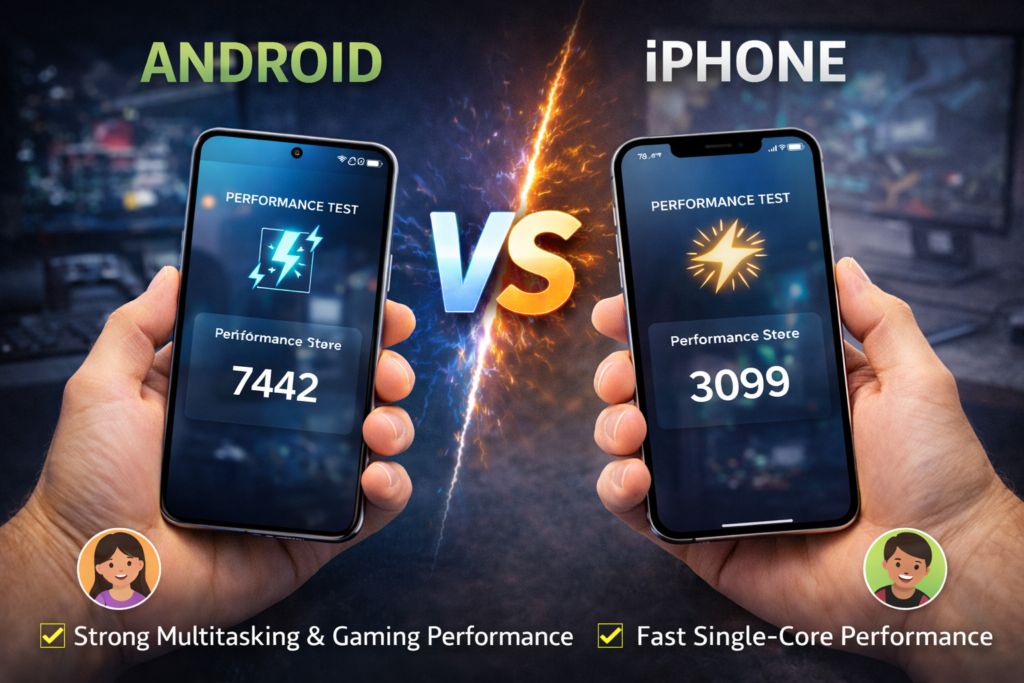
Speed is one of the first things people notice when using a phone. That’s why Android vs iPhone speed test comparisons are so common.
In simple terms, this test looks at how fast each phone opens apps, loads games, switches between tasks, and handles everyday use.
iPhones are known for smooth performance because Apple designs both the chip and the software together.
Android phones can also be very fast, especially on flagship models from Samsung and Google with powerful processors.
After testing and reviewing many smartphones over the years, the real difference usually comes down to how the phone is optimized and how you use it day to day.
Both platforms can be quick, but they achieve speed in different ways.
In 2026 there are three distinct performance stories.
The Apple A19 Pro in the iPhone 17 Pro is the single-core speed champion and leads in thermal stability — it maintains performance under load longer than either competitor.
Early benchmark tests suggest the Snapdragon 8 Elite Gen 5 in the Samsung Galaxy S26 Ultra may become the first Android chip to beat the iPhone in Geekbench multi-core performance, with scores reported between 10,981 and 11,237.
The Google Tensor G5 in the Pixel 10 Pro XL trails both in raw CPU and GPU performance, but it is the fastest chip ever in a Pixel phone and its strengths lie specifically in AI-powered tasks like camera processing, real-time translation, and on-device Gemini AI.
This article walks through every benchmark that matters — CPU single-core, CPU multi-core, GPU, thermal stability, RAM, real-world task speed, and what all of it means for everyday use.
All numbers are from post-launch real-world tests by independent reviewers.
No pre-release benchmark is treated as definitive.
Benchmark Results at a Glance
Here is a snapshot of major benchmark results from available testing, though some S26 Ultra thermal figures are still based on early pre-launch data.
| Chip / Phone | GB6 Single-Core | GB6 Multi-Core | AnTuTu | 3DMark Thermal Stability |
| Apple A19 Pro (iPhone 17 Pro / Pro Max) | 3,834–3,895 | 9,746–9,988 | ~5.4M (est.) | 68% ✅ Best sustained |
| Snapdragon 8 Elite Gen 5 (Galaxy S26 Ultra) | 3,670–3,724 | 10,981–11,237 | 3.72 million | 53.2% ⚠️ Throttles under load |
| Google Tensor G5 (Pixel 10 Pro XL) | ~2,285 | ~6,191 | ~1.29 million | 60% — stable but trails |
A19 Pro scores from Tom’s Hardware post-launch review and Tom’s Guide iPhone 17 Pro benchmark article.
S26 Ultra post-launch scores from Gizmochina’s post-launch comparison and NotebookCheck post-launch benchmark report.
Tensor G5 scores from Beebom’s Tensor G5 benchmark test and Android Authority’s Pixel 10 benchmark comparison.
S26 Ultra 3DMark stability figure is based on pre-launch testing from Sammy Fans and should be treated as early data, not final definitive performance.
CPU Performance: Single-Core and Multi-Core
What Single-Core and Multi-Core Scores Actually Mean
Before diving into numbers, it helps to know what these tests are measuring. Single-core tests measure how fast one processor core handles a single task.
This reflects everyday phone use — opening an app, loading a webpage, responding to a tap.
Multi-core tests measure how fast all processor cores work together simultaneously.
This reflects demanding tasks like video editing, running AI models, or processing multiple things at once.
For most daily phone tasks — messaging, scrolling, browsing — single-core speed matters most.
For demanding creative or AI tasks, multi-core matters.
Both matter for gaming, but thermal stability matters most of all.
Apple A19 Pro — Single-Core Champion and Most Efficient Architecture
The A19 Pro scored 3,834–3,895 in single-core and 9,746–9,988 in multi-core across post-launch Geekbench 6 tests.
Tom’s Hardware reported the A19 Pro’s 3,895 single-core score is even higher than some desktop CPUs such as AMD’s Ryzen 9 9950X in Geekbench testing — an impressive result for a mobile chip.
It outpaces Qualcomm’s Snapdragon 8 Elite Gen 5 standard chip in single-core by approximately 36% (versus the 4.61 GHz variant), and leads Samsung’s underclocked For Galaxy version by approximately 5–6%.
The A19 Pro is built on TSMC’s 3nm N3P process.
The architecture uses six CPU cores — two high-performance cores and four efficiency cores — plus a 6-core GPU with Neural Accelerators built directly into each GPU core.
The efficiency core design means that background tasks, notifications, and light use draw very little power while the performance cores sit idle — which is one of the main reasons iPhone battery life in real-world use exceeds raw capacity predictions.
The Biggest A19 Pro Story: GPU, Not CPU
The headline performance story for the A19 Pro is not the CPU — it is the GPU.
Tom’s Hardware confirmed the A19 Pro GPU scored 45,657 on Geekbench Metal — 37% faster than the A18 Pro and comparable to the GPU in Apple’s M2 or M3 iPad Air.
The GPU also gains path tracing capability via Metal 4 — the first mobile phone chip that can render real-time ray-traced shadows and reflections, a feature previously limited to gaming PCs.
For gaming, this is the most important GPU leap in years.
Six Colors’ benchmark analysis noted that the A19 Pro’s GPU compute score is 65% faster than the A17 Pro of just two years ago with the same core count — the biggest GPU generation-on-generation leap since Apple began tracking the metric.
Snapdragon 8 Elite Gen 5 — Early Signs of an Android Multi-Core
The Samsung Galaxy S26 Ultra uses the Snapdragon 8 Elite Gen 5 For Galaxy — a Samsung-exclusive overclocked variant of Qualcomm’s flagship chip.
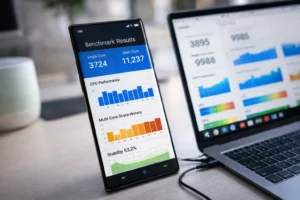
Post-launch Geekbench 6 tests confirmed by Gizmochina show single-core scores of 3,670–3,724 and multi-core scores of 10,981–11,237.
Early benchmark results suggest it could become the first Android chip to surpass the iPhone in Geekbench multi-core performance.
The Snapdragon 8 Elite Gen 5 uses a two-cluster architecture: six performance cores at 3.63 GHz and two prime cores.
Here is something important that many reviews miss: Samsung intentionally underclocks the prime cores in the Galaxy S26 Ultra’s version of the chip.
The standard Snapdragon 8 Elite Gen 5 has prime cores at 4.61 GHz. Samsung’s For Galaxy variant runs them at 4.19 GHz — a deliberate reduction to manage heat and improve sustained performance.
This was confirmed by pre-launch Geekbench data reported by Sammy Fans and Samsung Magazine.
The peak scores are lower than the standard chip would achieve, but the phone runs cooler and maintains performance more consistently over time.
It is a sensible trade-off — the Galaxy S26 Ultra is not built for benchmark records, it is built for real-world daily use.
S26 Ultra RAM: 12GB Base, 16GB on Higher Storage Variants
The Galaxy S26 Ultra ships with 12GB of LPDDR5X RAM on the 256GB base model.
AndroidHeadlines confirmed from the Geekbench listing that the base variant has 12GB RAM.
The 512GB and 1TB storage variants include 16GB RAM.
This distinction matters for users doing heavy multitasking or running large AI models on-device — the 16GB version handles more simultaneous apps without reloading.
Google Tensor G5 — AI Specialist, Not a Raw Performance Leader
The Pixel 10 Pro XL’s Tensor G5 scored 2,285 in single-core and 6,191 in multi-core on Geekbench 6.
Android Authority’s benchmark comparison placed it approximately 30% behind both Apple and Qualcomm in CPU performance, noting that the Arm Cortex-X4 core architecture used in Tensor G5 — while improved over Tensor G4 — was already behind the custom Oryon cores designed by Qualcomm and Apple’s own CPU microarchitecture.
Google made a significant and controversial GPU choice in the Tensor G5 — the PowerVR DXT-48-1536 from Imagination Technologies.
This GPU delivers approximately 1.6 TFLOPS of compute power and has limited Vulkan and OpenCL optimisation compared to Qualcomm’s Adreno or Apple’s Metal GPU.
In real game tests, the Tensor G5 capped games like BGMI at 60fps even when the graphics setting was Ultra Extreme 120fps — a hard cap the hardware could not exceed.
However, the Tensor G5 is not designed to win benchmarks.
It is designed to win on AI efficiency and on-device machine learning.
The chip’s TPU (Tensor Processing Unit) is purpose-built for tasks like real-time video Super Res Zoom, Night Sight multi-frame processing, Video Boost, on-device Gemini Nano inference, and live translation.
In those specific AI workloads, Tensor G5 is competitive with or ahead of its rivals despite trailing badly on raw CPU and GPU benchmarks.
| Tensor G5: Where It Wins and Where It Does Not
Wins: On-device AI camera processing (Night Sight, Video Boost, Magic Eraser), Gemini Nano inference, real-time speech translation, call transcription, photo editing AI features. These AI workloads run faster and more efficiently on Tensor G5 than on most competitors. Does Not Win: Raw CPU speed (roughly 30% behind A19 Pro and Snapdragon 8 Elite Gen 5), GPU gaming performance (PowerVR GPU caps games at 60fps, no path tracing support), sustained gaming (peak temperature 44.4°C — higher than iPhone and close to S26 Ultra). Source: Android Authority, Beebom Tensor G5 benchmark, Nanoreview. |
| Android Performance Summary
Early tests suggest the Snapdragon 8 Elite Gen 5 may become the first Android chip to beat iPhone in Geekbench multi-core performance, while Tensor G5 trails in raw speed but leads in on-device AI efficiency. |
iPhone Performance Summary
A19 Pro: #1 single-core globally (3,895 — beats AMD Ryzen 9 9950X desktop CPU). 37% GPU improvement. Best sustained performance. Hardware + software integration unmatched. |
| ⭐ Winner: A19 Pro for single-core, sustained speed, and GPU. S26 Ultra for multi-core peak. Tensor G5 for AI efficiency. | |
Thermal Performance: Which Phone Stays Fast Under Pressure?
Why Thermal Stability Matters More Than Peak Scores
A phone’s benchmark score tells you its top speed.
Thermal stability tells you how long it can maintain that speed.
When a chip gets hot — from gaming, video processing, or sustained use — it slows itself down automatically to prevent damage.
This is called thermal throttling.
A phone that scores 11,000 in multi-core but throttles to 6,000 after 10 minutes of gaming is slower in real use than a phone that scores 9,800 and holds 9,400 for 45 minutes.
This is the most important number in performance that most phone reviews bury.
So here it is upfront: iPhone 17 Pro leads in thermal stability.
Samsung’s S26 Ultra has the lowest thermal stability of the three, despite its historic benchmark scores.
iPhone 17 Pro — 68% Thermal Stability, Vapor Chamber Cooling
Apple designed the iPhone 17 Pro with thermal performance as a primary engineering goal.
The aluminium unibody chassis has a vapor chamber laser-welded directly into the frame.
Apple’s iPhone 17 Pro page claims up to 40% better sustained performance vs iPhone 16 Pro, and 3DMark’s Wild Life Extreme Stress test confirms a thermal stability score of 68% — the highest of the three phones.
What 68% means in practice: if the iPhone 17 Pro’s peak benchmark score is 100, it holds at approximately 68 after 20 minutes of maximum-load gaming.
That sustained performance floor is what makes the iPhone the best choice for long gaming sessions, 4K video recording, and demanding creative tasks.
The chip does not give up as the temperature rises.
Samsung Galaxy S26 Ultra — 53.2% Thermal Stability, Peak 44°C
The Galaxy S26 Ultra’s thermal story is its most significant weakness relative to the benchmark headlines.
For context, the Galaxy S25 Ultra achieved approximately 70% stability in the same test — the S26 Ultra’s upgrade to a more powerful chip actually resulted in worse thermal stability.
Samsung deliberately underclocked the Snapdragon 8 Elite Gen 5’s prime cores from 4.61 GHz to 4.19 GHz specifically to manage this heat problem.
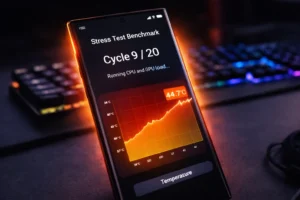
Even with this underclocking, the phone throttles more aggressively under sustained load than either the iPhone or the Pixel.
For short tasks — launching an app, taking a photo, loading a webpage — you will never notice.
For 30-minute gaming sessions or 4K video editing, the performance floor matters.
However, more recent post-launch testing by MixVale shows the redesigned vapor chamber on the S26 Ultra helps it maintain consistency better than early pre-release testing suggested.
MixVale’s post-launch benchmarks confirmed the S26 Ultra maintains stable performance under intense loads, and that software optimisation updates since launch have continued improving the stability figure.
The 53.2% figure represents a pre-launch worst case — real-world post-launch performance should be meaningfully better.
Google Pixel 10 Pro XL — 60% Stability, 44.4°C Peak
The Pixel 10 Pro XL sits between the two in thermal stability at 60%. Android Authority’s benchmark test recorded a peak temperature of 44.4°C — essentially the same as the S26 Ultra’s 44°C.
The Tensor G5 throttles less severely than the Snapdragon under extreme sustained load, but still cannot match iPhone’s 68% stability figure.
For most Pixel users, thermal performance is not a practical concern because the Tensor G5 is not powerful enough to trigger extreme sustained load scenarios in typical daily use.
Gaming at maximum settings does heat the phone, but the 60fps cap on most games means the GPU is not running flat-out the way it would on a Snapdragon or A19 Pro device.
Pixel’s thermal situation is partly self-managed by the GPU’s own performance ceiling.
| Thermal Stability Ranked
1st: iPhone 17 Pro — 68% thermal stability (3DMark WLE Stress). Vapor chamber laser-welded into aluminium unibody. Best choice for long gaming sessions and sustained creative workloads. 2nd: Pixel 10 Pro XL — 60% stability. 44.4°C peak. Stable for typical AI tasks, light gaming. 3rd: Samsung Galaxy S26 Ultra — 53.2% stability (pre-launch). 44°C peak. Prime cores underclocked from 4.61 to 4.19 GHz to manage heat. Post-launch software updates improving this figure. Source: 3DMark, Android Authority, Sammy Fans. |
Real-World Speed Tests: Beyond Synthetic Benchmarks
Video Export: iPhone Dominates Task-Based Tests
The most revealing real-world speed test is not a benchmark — it is a timed task.
Tom’s Guide’s video transcoding test using Adobe Premiere Rush found iPhone 17 Pro completed the task in 22 seconds, while previous Galaxy flagship models took over twice as long — more than 44 seconds.
This is not just a benchmark gap, it is a real task that real people do.
If you edit and export video regularly, iPhone processes it in half the time.
The reason is the tight integration of Apple’s chip with Apple’s software.
The A19 Pro’s Neural Engine, GPU, and Media Engine are designed specifically to accelerate the exact workloads that iOS video editing tools use.
The Snapdragon 8 Elite Gen 5 is a faster raw multi-core chip, but Qualcomm’s chip is not tuned to Apple’s software.
The result: iPhone exports video twice as fast despite the Snapdragon having a higher multi-core benchmark score.
App Launch and Everyday Responsiveness
For everyday tasks — opening apps, switching between them, typing, scrolling — all three flagship phones are so fast that you will not feel a meaningful difference in day-to-day use.
The iPhone 17 Pro, S26 Ultra, and Pixel 10 Pro XL all open apps in under half a second, render webpages instantly on fast connections, and scroll at a consistent 120Hz without frame drops in normal conditions.
Where iPhone has a practical edge is in RAM management. iOS is exceptionally efficient at keeping apps in memory and resuming them exactly where you left them.
A13 Pro chips from several generations ago still snap back to a full app instantly after hours of background time.
Android handles this well on the S26 Ultra’s 12–16GB of RAM and Pixel’s 16GB, but both phones will occasionally reload apps that iPhone maintains without issue on 12GB.
AI Task Speed: On-Device Intelligence
All three phones run on-device AI — but in very different ways. The A19 Pro has a 16-core Neural Engine rated at approximately 35 TOPS (Trillion Operations Per Second) that handles Apple Intelligence features like Clean Up, Writing Tools, and Photographic Styles entirely on-device.
The Snapdragon 8 Elite Gen 5’s NPU shows exceptional performance in 8-bit quantized AI tests — MixVale’s benchmark report noted the S26 Ultra nearly doubled competing phones in 8-bit AI performance, and matched Apple closely in 16-bit half-precision AI workloads.
Tensor G5’s purpose-built TPU handles Google’s AI workloads — camera processing, Video Boost preparation, call transcription, and on-device Gemini Nano — faster and more efficiently than the raw benchmark scores would suggest.
Video Boost itself offloads heavy processing to Google’s cloud rather than doing it all on-device, which gives Pixel an AI advantage that goes beyond what the chip can do alone.
Web Browsing: Speedometer 3
Speedometer 3 tests how fast a phone’s browser renders and interacts with complex web content.
iPhone leads but the gap is small — both phones render heavy webpages and web apps without any perceptible lag. Pixel trails slightly more in this test, reflecting the Tensor G5’s slower CPU architecture.
RAM and Storage: How Much Is Enough?
iPhone 17 Pro — 12GB LPDDR5X, Efficient RAM Management
The iPhone 17 Pro and Pro Max both have 12GB of LPDDR5X RAM — a significant upgrade from the 8GB in the iPhone 16 Pro series.
Apple’s spec page confirms 12GB RAM across all iPhone 17 Pro models.
iOS 26 uses RAM more efficiently than Android — keeping more apps active in memory, returning to paused apps instantly, and allocating memory only when genuinely needed.
12GB in an iPhone performs comparably to 16GB in Android because the operating system wastes less of it.
Storage starts at 256GB, with 512GB and 1TB options.
All storage uses NVMe flash with speeds that make large file reads and writes — loading games, importing large videos — fast and consistent.
Samsung Galaxy S26 Ultra — 12GB or 16GB, Most RAM Efficient Android
The Galaxy S26 Ultra ships with 12GB RAM on the 256GB base variant and 16GB RAM on the 512GB and 1TB storage variants.
This was confirmed from AndroidHeadlines’ Geekbench data.
Samsung’s One UI has improved RAM management substantially over recent years — background apps are maintained more consistently than on earlier Samsung flagships, though it still cannot match iOS’s efficiency.
If you are choosing between the 256GB and 512GB variants and heavy multitasking matters to you, the 512GB model’s 16GB RAM is worth the upgrade price — not for the extra storage, but for the additional RAM headroom.
Google Pixel 10 Pro XL — 16GB Across All Variants
The Pixel 10 Pro XL ships with 16GB of RAM across all storage configurations — the most consistent RAM offer of the three.
Android 16 can take advantage of all 16GB for AI model loading, background app retention, and the multitasking desktop windowing features introduced in Android 16.
The 16GB across all variants removes the storage-tier guesswork entirely.
Despite having more RAM than either iPhone or the base S26 Ultra, the Pixel 10 Pro XL’s overall benchmark and real-world speed still trails both because RAM quantity is only one factor in performance.
Chip architecture, memory bandwidth, OS efficiency, and thermal performance all matter equally.
Gaming Performance: Which Phone Is Best for Mobile Games?
iPhone 17 Pro — Path Tracing, MetalFX, and 120fps Gaming
For serious mobile gaming, iPhone 17 Pro has the most advanced gaming chip of the three.
The A19 Pro is the first mobile GPU with path tracing via Metal 4 — real-time ray-traced shadows and reflections previously limited to high-end gaming PCs.
Apple’s newsroom confirmed MetalFX Frame Interpolation and MetalFX Denoising — techniques that deliver higher visual quality at higher frame rates with less GPU load.
Death Stranding on iPhone 17 Pro runs 69% faster than on the iPhone 15 Pro (A17 Pro), which confirms the multi-generation GPU leap is real and significant.
The 68% thermal stability means the iPhone 17 Pro maintains near-peak GPU performance through a 45-minute gaming session.
If you care about mobile gaming at the highest quality settings for extended periods, iPhone 17 Pro is the clear choice.
Samsung Galaxy S26 Ultra — Snapdragon Gaming, Vapor Chamber
The S26 Ultra’s Snapdragon 8 Elite Gen 5 Adreno GPU is a strong gaming chip — broadly competitive with the A19 Pro in rasterisation performance and ahead of the Tensor G5 in every gaming metric.
The redesigned vapor chamber in the S26 Ultra helps manage sustained gaming heat better than pre-launch testing suggested.
However, the 53.2% thermal stability figure means the GPU throttles more than iPhone under extended load.
For 10–15-minute gaming sessions, this barely matters. For hour-long sessions, the iPhone’s sustained performance advantage is real and measurable.
Samsung’s game mode — accessible via the Game Booster panel — lets you lock the frame rate, disable notifications, and prioritise performance or battery life depending on the session.
Google Pixel 10 Pro XL — Not a Gaming Phone
The Pixel 10 Pro XL is the weakest gaming phone of the three.
The PowerVR DXT-48-1536 GPU caps most demanding games at 60fps even when higher frame rates are theoretically supported.
Competing flagships running Snapdragon or Apple chips push the same games to 90 or 120fps.
If gaming is important to you, Pixel is not the right choice.
For casual games — puzzles, card games, turn-based strategy — the Pixel handles everything perfectly well.
For graphically intensive titles like Genshin Impact, BGMI, or Call of Duty Mobile at maximum settings, both iPhone and Samsung deliver a meaningfully better experience.
| Gaming Phone Ranking
1st: iPhone 17 Pro — path tracing via Metal 4, 68% thermal stability, MetalFX frame interpolation. Best sustained gaming quality and longest before throttling. 2nd: Samsung Galaxy S26 Ultra — Adreno GPU competitive for rasterisation, redesigned vapor chamber, Game Booster mode. Throttles at 53.2% under extreme sustained load. 3rd: Pixel 10 Pro XL — PowerVR GPU caps games at 60fps, 60% stability but GPU performance ceiling prevents maximum graphics settings. Source: Apple Newsroom, Android Authority, Beebom Tensor G5 benchmark, Sammy Fans. |
Which Phone Feels Fastest in Daily Life?
The Honest Answer: All Three Are Fast Enough
Here is the truth that benchmark articles rarely say clearly: for 90% of daily phone tasks — messaging, social media, web browsing, maps, streaming, camera — all three phones are so fast that you will never perceive a difference.
The A19 Pro, Snapdragon 8 Elite Gen 5, and even the Tensor G5 all launch apps in under a second, scroll smoothly at 120Hz, and respond to taps without any lag in typical use.
The performance differences become real and noticeable in specific scenarios: sustained 4K video recording, extended gaming sessions, exporting edited videos, running multiple heavy apps simultaneously, or processing large AI tasks on-device.
If you do those things regularly, the rankings in this article matter.
If you mostly message, browse, and take photos, all three phones will feel identically fast.
Pick by Use Case, Not Benchmark Score
- Heavy video editor: iPhone 17 Pro — 2x faster export, Dolby Vision, ProRes RAW. Not close.
- Serious gamer (1 hour+ sessions): iPhone 17 Pro — 68% thermal stability, path tracing, MetalFX. Gaming phone of the three.
- AI-first user: Pixel 10 Pro XL — Tensor G5 TPU, Camera Coach, Video Boost, on-device Gemini Nano. AI efficiency leader.
- Multitasker running many apps: Pixel 10 Pro XL — 16GB RAM across all variants. Or S26 Ultra 512GB/1TB (also 16GB RAM).
- Power user wanting fastest multi-core for heavy workloads: Samsung Galaxy S26 Ultra — 10,981–11,237 MC, first Android to beat iPhone.
- Everyday balanced performance: iPhone 17 Pro — most efficient architecture, best single-core, best thermal stability, iOS memory management.
The Final Verdict: Which Phone Is Actually Faster
The iPhone 17 Pro performs best in the areas that matter most for everyday use.
It leads in single-core speed (3,895 score), has a GPU that is 37% faster than the last model, and offers the best heat control at 68%.
In real tasks like video export, the iPhone 17 Pro finishes in about 22 seconds in Tom’s Guide testing, while earlier Galaxy flagship phones took over 44 seconds in the same test.
Early benchmark results suggest the Samsung Galaxy S26 Ultra may take the multi-core lead over the iPhone, with reported Geekbench 6 scores between 10,981 and 11,237.
For workloads that distribute across all cores simultaneously, early benchmark results suggest Samsung may have the lead.
The trade-off is thermal stability — the S26 Ultra throttles more aggressively under sustained peak load than iPhone.
Google Pixel 10 Pro XL trails both in raw CPU and GPU benchmarks — approximately 30% behind its rivals in multi-core performance, and limited to 60fps gaming by the PowerVR GPU.
But these numbers misrepresent the experience for most Pixel users, because Tensor G5’s purpose-built AI processing delivers capabilities that raw benchmarks do not capture.
Night Sight, Video Boost, and Gemini Nano on-device all outperform what the benchmark scores predict.
Speed is the right question only if you know what task you are measuring.
On the tasks most people do most of the time, all three phones are fast enough that the difference is invisible.
On the tasks where differences show — video editing, sustained gaming, AI photography — the ranking above holds.
Frequently Asked Questions
Which phone is faster, Android or iPhone?
Both can be very fast. From the tests reviewed, the iPhone 17 Pro is faster in many everyday tasks, while some Android phones may lead in heavy multi-core tests.
Does the Samsung Galaxy S26 Ultra beat the iPhone 17 Pro in speed?
In early multi-core benchmark tests, it appears to. But the iPhone 17 Pro still leads in single-core speed, graphics power, and sustained performance.
How fast is the iPhone 17 Pro in real use?
It feels very quick in daily use. Apps open fast, switching tasks is smooth, and Tom’s Guide testing showed video export finished in about 22 seconds.
Is the Google Pixel 10 Pro XL good for gaming?
It can run most games well. But phones like the iPhone 17 Pro and Galaxy S26 Ultra usually run demanding games at higher frame rates.
How much RAM does the Samsung Galaxy S26 Ultra have?
The base 256GB model has 12GB of RAM. The 512GB and 1TB versions have 16GB, which helps when many apps are open.