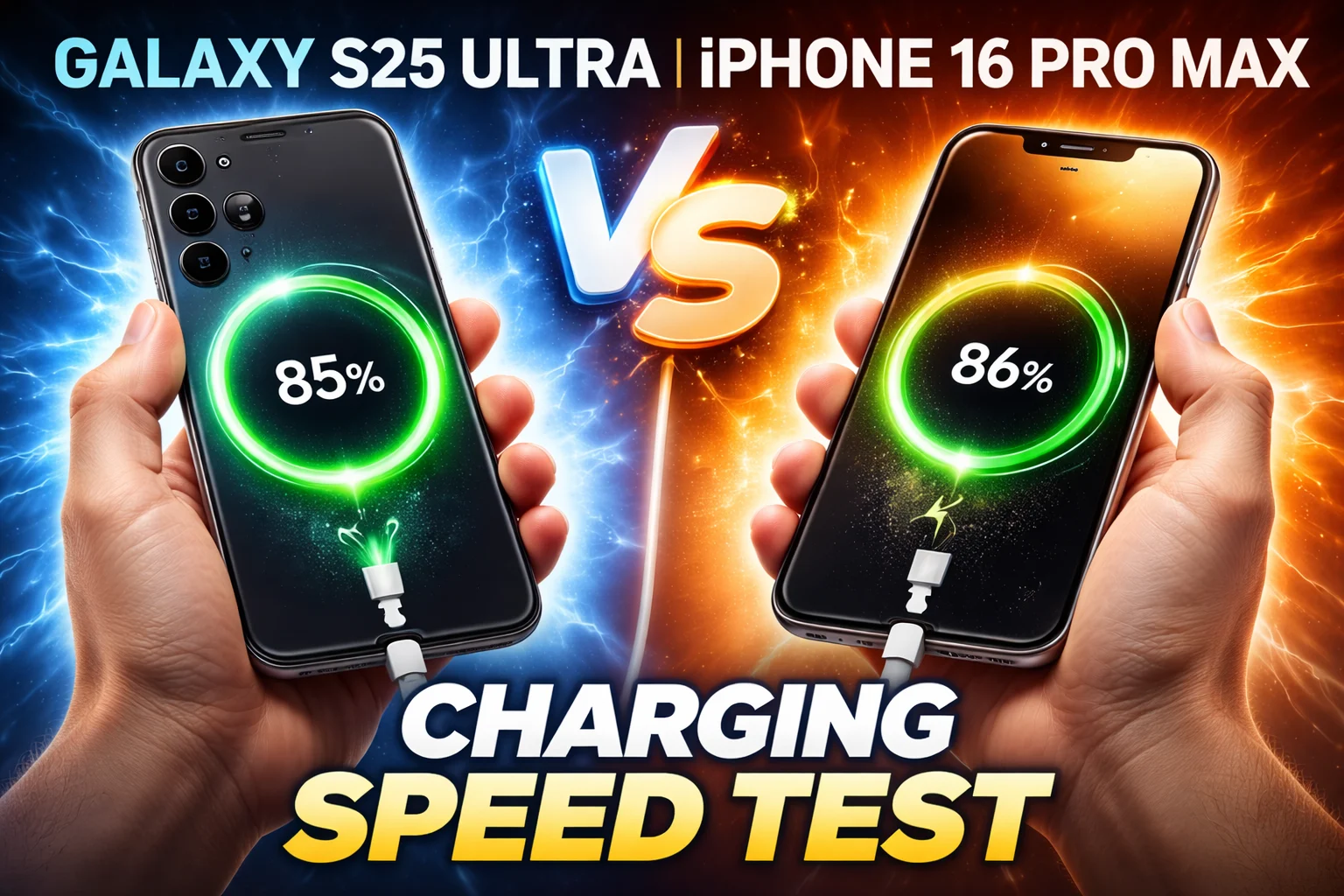
Choosing between the iPhone 16 Pro vs Samsung Galaxy S25 Ultra can feel like picking between two tech giants that both promise the best smartphone experience.
Apple’s iPhone 16 Pro focuses on smooth performance, tight integration with the Apple ecosystem, and a polished, user-friendly design.
On the other hand, Samsung’s Galaxy S25 Ultra stands out with its massive display, powerful zoom cameras, and deep customization through Android.
If you love simplicity, long-term software support, and seamless syncing with other Apple devices, the iPhone may win you over.
But if you prefer flexibility, cutting-edge camera features, and a feature-packed device, the Galaxy S25 Ultra is hard to beat.
Quick Verdict — Read This First
The Samsung Galaxy S25 Ultra wins on raw hardware: bigger battery (5,000 mAh vs 3,582 mAh), more versatile cameras, and higher multi-core performance.
The iPhone 16 Pro wins where numbers fall short: better sustained screen brightness in lab tests (1,796 nits vs 1,417 nits), superior low-light photography, class-leading video, and seamless Apple ecosystem integration.
Your choice should come down to how you actually use a phone every day, not spec sheets alone.
Full Specifications Comparison
All specifications are verified from Apple, Samsung, GSMArena, PhoneArena, and Tech Advisor as of March 2026.
Both phones were released in 2024 and 2025 respectively and remain the flagship models from their brands.
| Specification | iPhone 16 Pro | Samsung S25 Ultra |
| Released | September 2024 | February 2025 |
| Display Size | 6.3″ | 6.9″ |
| Display Type | Super Retina XDR OLED | Dynamic AMOLED 2X |
| Resolution | 2556 x 1179 (460 ppi) | 3120 x 1440 (510 ppi) |
| Peak Brightness (spec) | 2,000 nits | 2,600 nits |
| Sustained Brightness (lab) | 1,796 nits (GSMArena) | 1,417 nits (GSMArena) |
| Refresh Rate | 1-120Hz ProMotion | 1-120Hz Adaptive |
| Processor | Apple A18 Pro (3nm) | Snapdragon 8 Elite for Galaxy (3nm) |
| RAM | 8GB LPDDR5X | 12GB LPDDR5X |
| Storage Options | 128GB / 256GB / 512GB / 1TB | 256GB / 512GB / 1TB |
| Main Camera | 48MP (f/1.78) | 200MP (f/1.7) |
| Ultra Wide | 48MP (f/2.2) | 50MP (f/1.9) |
| Telephoto | 12MP, 5x optical (120mm) | 50MP 5x + 10MP 3x |
| Max Zoom | 5x optical / 25x digital | 10x optical / 100x Space Zoom |
| Front Camera | 12MP TrueDepth, f/1.9, OIS | 12MP f/2.2 |
| Video | 4K @ 120fps, ProRes, Log | 8K @ 30fps / 4K @ 120fps, Log |
| Battery | 3,582 mAh (Pro) | 5,000 mAh |
| Wired Charging | ~30W, 50% in 30 min | 45W Super Fast 2.0, 65% in 30 min |
| Wireless | MagSafe 25W / Qi2 15W | Qi2 15W (no MagSafe magnets) |
| Frame | Titanium Grade 5 | Titanium Grade 5 |
| Front Glass | Ceramic Shield | Gorilla Armour 2 |
| IP Rating | IP68 (6m / 30 min) | IP68 (1.5m / 30 min) |
| S Pen | No | Yes (no Bluetooth in 2025 model) |
| Weight | 199 g | 218g |
| OS | iOS 18 | Android 15 / One UI 7 |
| Software Support | 5 yrs written min; 6-7 yrs historical | 7 years (committed in writing) |
| Starting Price (US) | $999 (Pro) / $1,199 (Pro Max) | $1,299 |
Design and Build Quality
iPhone 16 Pro: Refined and Purposeful
The iPhone 16 Pro uses a Grade 5 titanium frame, the same alloy used in surgical tools and aircraft.
Apple’s Ceramic Shield front glass claims 50% better drop protection than standard glass.
The phone weighs 227g in the Pro Max version and adds two new buttons this generation that previous iPhones never had.


New Buttons on the iPhone 16 Pro
- Action Button: Replaces the old mute switch. You can set it to open the camera, run a shortcut, toggle torch, and more.
- Camera Control: A capacitive button on the right side. Tap it to shoot, swipe to zoom, press to adjust settings without touching the screen.
- USB-C with USB 3 speeds up to 10Gbps, a major step up from the Lightning port on older iPhones.
- IP68 rated to 6 metres for 30 minutes, the deepest water resistance Apple has offered.
Samsung Galaxy S25 Ultra: Redesigned for 2025
Samsung gave the S25 Ultra its most significant frame redesign in years.
It moved from flat angular edges to rounded titanium corners, making it feel more comfortable in the hand and visually more in line with the rest of the S25 range.
At 218g it is 9g lighter than the iPhone 16 Pro Max, a difference you feel after a full day of use.
What Changed on the S25 Ultra in 2025
- Rounded titanium frame: More ergonomic than the sharp flat edges on the S24 Ultra.
- Gorilla Armour 2: Samsung’s anti-reflective glass cuts glare more effectively than the previous generation and offers improved scratch resistance.
- S Pen without Bluetooth: The stylus is still built in, but Samsung removed Bluetooth this year. Air Actions, which let you control the phone remotely with the pen, are no longer possible.
- Thinner bezels: The S25 Ultra grew from 6.8 to 6.9 inches by slimming the frame around the display, not by making the phone bigger.
- IP68 rated to 1.5 metres for 30 minutes. Both phones are IP68 but Apple’s depth rating is 4x deeper.
Display Technology
The Brightness Paradox Every Buyer Needs to Know
Samsung’s 2,600 nit peak brightness looks dominant on paper.
But GSMArena’s controlled lab tests measured sustained auto brightness differently: the iPhone 16 Pro Max reached 1,796 nits while the S25 Ultra measured 1,417 nits in the same conditions.
Samsung’s 2,600 nit figure refers to a brief HDR burst, not what you get all day.
Samsung closes the gap through Gorilla Armour 2.
Less reflected glare means the S25 Ultra screen reads more comfortably outdoors even at lower raw brightness.
For buyers in bright sun environments like Dubai, Sydney, or Miami, both phones perform well outside but for different reasons.
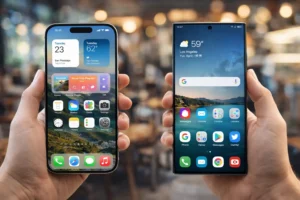
Display Comparison Table
| Feature | iPhone 16 Pro | S25 Ultra | Winner |
| Screen Size | 6.3″ / 6.9″ (Pro Max) | 6.9″ | Tie (Pro Max) |
| Resolution | 2556 x 1179 | 3120 x 1440 | Samsung |
| Peak Brightness (spec) | 2,000 nits | 2,600 nits | Samsung (spec) |
| Sustained Brightness (lab) | 1,796 nits (brighter) | 1,417 nits | Apple |
| Anti Reflective Glass | Good | Gorilla Armour 2 (Excellent) | Samsung |
| ProScaler Upscaling | No | Yes (fewer artifacts) | Samsung |
| Refresh Rate | 1-120Hz ProMotion | 1-120Hz Adaptive | Tie |
| Always On Display | Yes (1 nit min) | Yes | Tie |
| Color Accuracy | Excellent (warmer) | Very Good (AI processed) | Apple |
Color Accuracy and Media Consumption
Apple’s Super Retina XDR leads in color accuracy with warmer, more natural tones that photographers and video editors prefer.
Samsung’s ProScaler technology reduces artifacts when streaming lower resolution content by up to 40%, which makes a real difference when watching older shows or YouTube videos that are not in 4K.
Performance and Processing Power
Two Different Strengths
The A18 Pro in the iPhone 16 Pro leads in single-core performance.
This is what makes everyday tasks feel fast: app launches, scrolling, photo processing, and responding to taps.
The Snapdragon 8 Elite in the S25 Ultra wins in multi-core workloads, which matters when running several demanding apps at once.
The S25 Ultra also has 12GB of RAM versus the iPhone’s 8GB. Switching across a dozen open browser tabs, a video editor, and messaging apps stays noticeably smoother on the Samsung.
Apple’s iOS memory management compensates well, but heavy multitaskers will notice the difference.
Benchmark Comparison Table
| Performance | iPhone 16 Pro (A18 Pro) | S25 Ultra (Snapdragon 8 Elite) |
| Geekbench 6 Single Core | ~3,285 (winner) | ~3,184 |
| Geekbench 6 Multi Core | ~8,387 | ~9,413 (winner) |
| RAM | 8GB LPDDR5X | 12GB LPDDR5X |
| Thermal Cooling | Passive (titanium frame) | Vapor chamber cooling |
| Gaming Sustain | Throttles sooner under heat | Better sustained gaming performance |
| AI Neural Engine | 16-core Apple Neural Engine | Snapdragon AI NPU |
| AnTuTu v10 (avg) | ~1,838,000 – 1,948,000 | ~2,207,000 – 2,731,000 |
What the Numbers Mean in Real Life
For everyday use, scrolling social media, making calls, browsing the web, both phones feel equally fast.
The performance gap becomes clear during video exports, large file transfers, gaming sessions over 30 minutes, and background processing.
The S25 Ultra’s vapor chamber cooling also helps it hold peak speed longer without throttling, which is a practical advantage the benchmark scores do not fully capture.
5. Camera Systems
Two Different Approaches to Photography
Apple uses computational photography to make every shot look great without any effort.
Samsung gives you raw power and versatility, with a 200MP main sensor and a zoom range that no iPhone can match. Neither is objectively better.
They serve different types of photographers.
Camera Comparison Table
| Camera | iPhone 16 Pro | S25 Ultra | Winner |
| Main Sensor | 48MP f/1.78, 24mm | 200MP f/1.7, 24mm | Samsung (detail) |
| Ultra Wide | 48MP f/2.2 | 50MP f/1.9 | Tie |
| Telephoto | 12MP, 5x optical | 50MP 5x + 10MP 3x | Samsung |
| Max Digital Zoom | 25x | 100x Space Zoom | Samsung |
| Low Light | Excellent, consistent | Good (noisy at times) | Apple |
| Skin Tones / Portrait | Warmer, natural | AI processed, accurate | Apple |
| Video (quality) | 4K/120fps ProRes (best OIS tested) | 8K capable, 4K/120fps Log | Apple |
| Front Camera | 12MP f/1.9, OIS, 3D sensor | 12MP f/2.2 | Apple |
| AI Photo Editing | Basic | Advanced Galaxy AI | Samsung |
iPhone 16 Pro Camera: Where It Wins
Low Light and Portrait Photography
Tech Advisor’s independent testing found the iPhone 16 Pro Max leads in low-light consistency and portrait photography.
Skin tones are warmer and more natural.
The Photonic Engine processes images before saving, which means photos need less editing to look their best straight from the camera.
Video: The iPhone’s Clearest Advantage
The iPhone 16 Pro shoots 4K at 120fps in Log format with Dolby Vision HDR.
Its sensor-shift optical stabilization is the most effective tested on any smartphone.
For YouTubers, filmmakers, and content creators, the iPhone 16 Pro is the more capable tool.
The Camera Control button adds a physical way to shoot and adjust settings without touching the glass.
Front Camera
Apple’s 12MP front camera includes optical stabilization and a 3D depth sensor used for Face ID.
Its f/1.9 aperture collects more light than Samsung’s f/2.2 front camera. In low light video calls and selfies, the iPhone front camera has a clear edge.
Samsung S25 Ultra Camera: Where It Wins
The 200MP Main Sensor
In good light, the S25 Ultra’s 200MP sensor captures extraordinary detail.
Samsung’s AI-powered ProVisual Engine processes colors and skin tones more naturally than previous Galaxy generations.
However, PhoneArena reviewers noted the 3x telephoto still uses an older 10MP sensor, which limits quality at that distance compared to the rest of the camera system.
100x Space Zoom
The S25 Ultra’s dual telephoto system gives you 5x and 3x optical lenses plus digital zoom to 100x.
The sweet spot is 10x to 30x, where quality remains impressive.
For wildlife, sports, concerts, and travel photography, this zoom range is a genuine real-world advantage that no iPhone currently offers.
Galaxy AI Photo Editing
Samsung’s built-in AI tools, including object removal, sky replacement, and Generative Edit, are more advanced than anything Apple offers natively on the iPhone 16 Pro.
For quick social media edits without a third-party app, the S25 Ultra is the faster workflow.
Battery Life and Charging
Raw Capacity vs Real World Endurance
The S25 Ultra’s 5,000 mAh battery is 39% larger than the iPhone 16 Pro’s 3,582 mAh.
In real daily use, S25 Ultra users consistently end the day with 10 to 15% battery remaining under moderate to heavy use.
iPhone 16 Pro users in the same usage pattern typically need a charge by late afternoon.
Note: The iPhone 16 Pro Max (not the Pro) carries a larger battery and closes the gap significantly.
If battery life is your top concern, consider the Pro Max version of the iPhone rather than the standard Pro model.
6.2 Battery and Charging Table
| Battery Feature | iPhone 16 Pro | S25 Ultra |
| Battery Capacity | 3,582 mAh (Pro) | 5,000 mAh |
| Capacity Advantage | Baseline | 39% larger |
| Wired Charging Speed | ~30W peak | 45W Super Fast 2.0 |
| 0-50% Wired | ~28-30 minutes | ~20 minutes |
| Full Charge (wired) | ~2 hours | ~1 hour |
| Wireless Charging | MagSafe 25W | Qi2 15W |
| Real World Endurance | May need midday charge (heavy use) | 10-15% left at end of day |
| Reverse Wireless | Yes | Yes |
Charging: Samsung Wins on Speed, Apple on Wireless
The S25 Ultra reaches a full charge in about one hour at 45W.
The iPhone takes closer to two hours.
However, Apple’s MagSafe delivers 25W wirelessly compared to Samsung’s 15W Qi2, making the iPhone the faster wireless charger.
For daily wireless top-ups on a charging pad, the iPhone recharges significantly quicker without a cable.
Software and Ecosystem
iOS 18 and the Apple Ecosystem
If you already own a Mac, iPad, or Apple Watch, the iPhone 16 Pro’s ecosystem benefits often outweigh its hardware limitations.
Universal Clipboard lets you copy text on iPhone and paste it on Mac.
AirDrop transfers files in seconds. Continuity Camera turns the iPhone into a high-quality Mac webcam.
These time-saving tools add up to hours saved every year.
Apple Intelligence Features in iOS 18
- Writing Tools: Rewrite, summarize, or proofread text in any app.
- Clean Up: Remove unwanted objects from photos with one tap.
- Notification Summaries: Group and condense alerts so you see what matters first.
- Smarter Siri: More context-aware responses and on-screen awareness.
Android 15 and One UI 7 on Samsung
Samsung’s One UI 7 offers deeper customization than iOS and Galaxy AI tools that go further than Apple Intelligence at launch.
Live Translate works in real-time during phone calls.
Chat Assist polishes messages before you send them.
The S Pen supports handwriting to text conversion and PDF annotation, making the phone genuinely useful as a note-taking tool without needing a separate tablet.
Samsung DeX: A Desktop in Your Pocket
Connect the S25 Ultra to a monitor and it becomes a full desktop workstation through Samsung DeX.
For business travelers who work from hotel rooms, this has no iPhone equivalent.
Pair it with a Bluetooth keyboard and you have a capable work setup without carrying a laptop.
Software Update Support
Samsung has committed in writing to 7 years of major Android OS and security updates from the S25 Ultra’s February 2025 launch.
Apple has not made an equivalent formal written pledge. Apple’s documented written minimum is 5 years per its UK PSTI compliance filing, though its historical average is 6 to 7 years of major iOS updates.
For buyers planning to keep a phone 4 or more years, both options are safe choices.
Price and Value
Price by Storage Tier
Prices verified as of March 12, 2026. Confirm current pricing directly with Apple, Samsung, or your local retailer before purchasing.
| Storage | iPhone 16 Pro (US) | S25 Ultra (US) | iPhone 16 Pro (UAE) | S25 Ultra (UAE) |
| 128GB | $999 (Pro only) | N/A | AED 4,299 | N/A |
| 256GB | $1,099 | $1,299 | AED 4,699 | AED 5,499 |
| 512GB | $1,299 | $1,419 | AED 5,499 | AED 5,999 |
| 1TB | $1,499 | $1,659 | AED 6,299 | AED 6,999 |
Global Price Comparison
| Region | iPhone 16 Pro (256GB) | S25 Ultra (256GB) |
| United States | $1,099 | $1,299 |
| UAE (AED) | AED 4,699 | AED 5,499 |
| United Kingdom (GBP) | £1,099 | £1,249 |
| India (INR) | ₹1,19,900 | ₹1,29,999 |
| Australia (AUD) | AUD 2,149 | AUD 2,149 (same entry price) |
Resale Value and Long-Term Cost
iPhones historically hold resale value better than Android flagships.
A two-year-old iPhone Pro typically sells for 50 to 60% of its original price.
Android flagships typically drop to 30 to 45% in the same period.
Over a three-year ownership cycle, this difference can meaningfully reduce the effective total cost of the iPhone despite its lower starting price.
Decision Guide
| Choose iPhone 16 Pro If… | Choose S25 Ultra If… |
| You use a Mac, iPad, or Apple Watch daily | Battery life is your biggest daily frustration |
| You shoot video content for YouTube or events | You photograph wildlife, sport, or distant subjects |
| You want clean low light photos with no editing | You want a built in stylus for notes and sketches |
| MagSafe wireless charging is part of your routine | You use a Windows PC for work |
| Resale value and long term support matter to you | You prefer Android freedom and customization |
| You want the best front camera for selfies and calls | You want 8K video or 100x zoom capability |
| You are already invested in the Apple ecosystem | You need DeX desktop mode while traveling |
Specific Use Cases
For Outdoor and Travel Users
The S25 Ultra’s 100x zoom and full day battery make it the better travel and outdoor phone.
The anti-reflective Gorilla Armour 2 display is easier to read in bright sunlight.
Live Translate is especially useful in foreign-language environments.
The iPhone’s smaller form factor in the Pro (not Pro Max) version makes it easier to carry all day.
For Students and Young Professionals
The S Pen makes the S25 Ultra a compelling note-taking device that can partly replace a separate tablet.
Students already using Samsung tablets or Galaxy PCs benefit from DeX mode.
iPhone remains the better choice in Apple-heavy school or university environments where AirDrop and shared Apple tools are part of daily life.
For Business and Corporate Users
Business users on Microsoft 365, Teams, or Windows laptops will find the S25 Ultra integrates more smoothly.
Samsung DeX turns the phone into a desktop workstation on the road.
iPhone is the cleaner fit in companies already running Apple Business Manager, enterprise MDM, or Apple-native security tools.
For Content Creators
Videographers and YouTubers should choose the iPhone 16 Pro.
Its 4K/120fps Log video, superior stabilization, and Dolby Vision color grading compatibility make it the professional video tool of the two.
Photographers who prioritize zoom range and AI photo editing will prefer the S25 Ultra.
Both phones are used professionally, but the right one depends entirely on your content type.
Regional Availability and Pricing
Prices are correct as of March 12, 2026 and may vary by retailer, carrier promotion, and region.
Always confirm current pricing directly with Apple, Samsung, or your local carrier before purchasing.
United States
iPhone 16 Pro starts at $999 for 128GB and $1,099 for 256GB.
The S25 Ultra starts at $1,299 for 256GB. Both are available unlocked and through AT&T, Verizon, and T-Mobile.
Trade-in deals from both Apple and Samsung frequently reduce effective prices by $200 to $800 depending on your existing device.
United Kingdom
iPhone 16 Pro Max starts at £1,199 for 256GB. Galaxy S25 Ultra starts at £1,249 for 256GB.
Both are available at Currys, John Lewis, and carrier stores.
UK buyers should note that S25 Ultra international models support dual physical SIM, while the US version is eSIM only.
UAE and Middle East
iPhone 16 Pro starts at AED 4,299 and the S25 Ultra at AED 5,499 for 256GB.
Both are widely available through Sharaf DG, eXtra, Jumbo Electronics, and Carrefour.
The S25 Ultra’s anti-reflective Gorilla Armour 2 display is especially well suited for Dubai’s bright outdoor conditions. Both phones support the UAE’s 5G networks fully.
India
iPhone 16 Pro starts at approximately ₹1,19,900 and the S25 Ultra at ₹1,29,999.
Both are available through Amazon India, Flipkart, and official brand stores.
Samsung frequently runs exchange offers that can reduce the effective S25 Ultra price by ₹10,000 to ₹20,000.
Australia
iPhone 16 Pro Max starts at AUD 2,149 for 256GB and the S25 Ultra also starts at AUD 2,149, making them identically priced at the entry level in Australia.
Higher storage tiers favour Apple slightly in price. Both support Telstra, Optus, and Vodafone 5G networks.
Final Verdict
Samsung Galaxy S25 Ultra Wins On
- Battery capacity: 5,000 mAh vs 3,582 mAh, 39% larger
- Camera zoom range: 100x vs 25x digital
- Multi-core CPU performance: 9,413 vs 8,387 Geekbench 6
- RAM: 12GB vs 8GB
- Anti-reflective outdoor display: Gorilla Armour 2
- AI photo editing tools: Object removal, Generative Edit, sky replacement
- Wired charging speed: 45W full charge in one hour vs two hours
- S Pen for notes, sketches, and document annotation
- Software update commitment: 7 years in writing
- Android customization and DeX desktop mode
iPhone 16 Pro Wins On
- Sustained display brightness in lab tests: 1,796 nits vs 1,417 nits
- Single-core CPU performance: A18 Pro leads by approximately 15%
- Video recording: 4K at 120fps ProRes with the best stabilization tested on any smartphone
- Low-light photography and portrait accuracy
- Front camera: f/1.9 aperture, OIS, 3D sensor
- Wireless charging speed: MagSafe 25W vs Qi2 15W
- Apple ecosystem: Mac, iPad, Apple Watch integration
- Resale value: Holds price better over two to three years
- Starting price: $999 vs $1,299
- Speaker quality: Louder and clearer in independent testing
The Samsung Galaxy S25 Ultra is the more powerful device on most hardware measures.
The iPhone 16 Pro offers software polish, ecosystem integration, and resale value that make it the right choice for millions of buyers.
Pick the one that fits your daily life, not the one with the bigger spec sheet numbers.
Frequently Asked Questions
Is the Samsung S25 Ultra faster than the iPhone 16 Pro?
It depends on the task. The iPhone 16 Pro’s A18 Pro chip leads in single-core performance by about 15%, making everyday tasks like app launches and scrolling feel snappier.
The Snapdragon 8 Elite in the S25 Ultra wins in multi-core workloads, scoring 9,413 vs 8,387 in Geekbench 6, making it better for heavy multitasking and sustained gaming. For most users, both phones feel equally fast in daily use.
Does the iPhone 16 Pro have a better camera than the S25 Ultra?
Neither is definitively better. The iPhone 16 Pro leads in low-light photography, video recording at 4K/120fps Log, portrait accuracy, and front camera quality.
The S25 Ultra leads in zoom capability up to 100x, AI photo editing, and versatility with four rear cameras. Professional videographers prefer the iPhone. Photographers who need zoom prefer the Samsung.
Which phone has better battery life?
The Samsung S25 Ultra has meaningfully better battery life for heavy users. Its 5,000 mAh battery is 39% larger than the iPhone 16 Pro’s 3,582 mAh, and tests show S25 Ultra users typically end the day with 10 to 15% charge remaining. The S25 Ultra also charges fully in about one hour at 45W versus two hours for the iPhone. For wireless charging, MagSafe at 25W is faster than the S25 Ultra’s 15W Qi2.
Is the iPhone 16 Pro worth it if I already use Android?
Switching from Android to iPhone means losing sideloading, deep file access, and full customization.
If you use Google apps, a Windows PC, or non-Apple services, the switch adds friction without a guaranteed better experience. For Android users staying in the ecosystem, the S25 Ultra is the smoother and more feature-rich choice.
Which phone is better value for the price?
The iPhone 16 Pro starts at $999, which is $300 less than the S25 Ultra’s $1,299 entry price, and includes the 128GB option Samsung does not offer.
iPhones hold resale value better, reducing the effective cost over time. However, the S25 Ultra offers more hardware out of the box including the S Pen, four cameras, a larger battery, and a brighter display spec, making it better raw hardware value at the price paid.
Sources and References
All specifications and benchmark data verified via: Apple.com · Samsung.com · GSMArena (March 2026) ·
Tech Advisor · PhoneArena · TechRadar · Tom’s Guide · Mark Ellis Reviews · The Film Alliance. Regional prices confirmed March 12, 2026 from Apple UAE, Ecity UAE, Jumbo Electronics, and regional retail listings.
All claims are verified against independent lab testing from GSMArena, PhoneArena, Tech Advisor, TechRadar, and Tom’s Guide before publication. This guide is updated whenever significant new testing data becomes available.