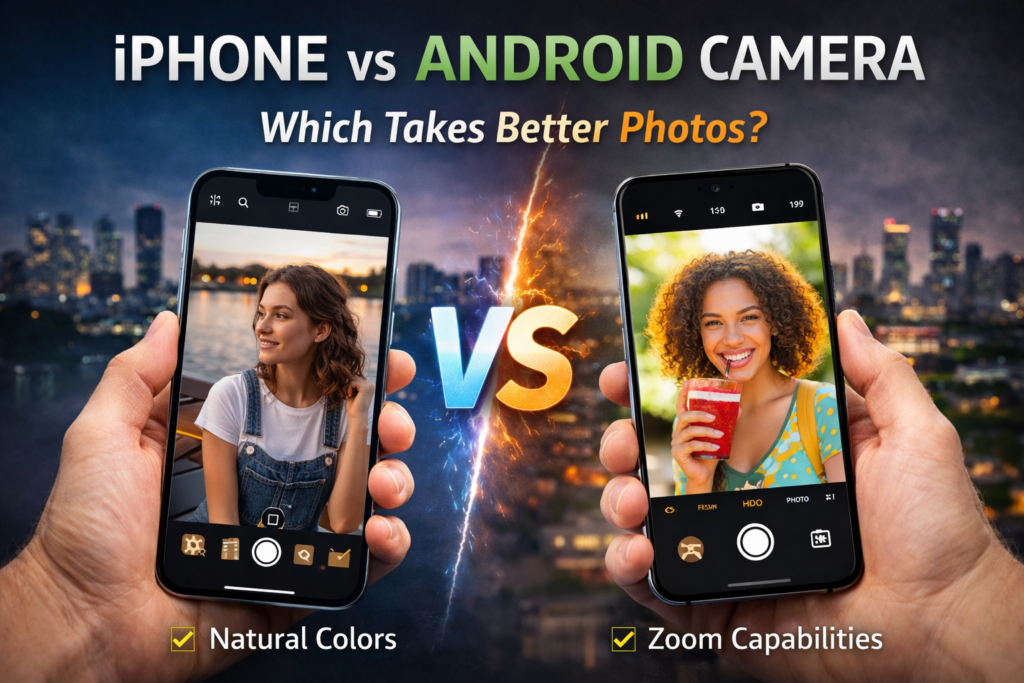
When people compare iPhone vs Android camera, they’re really asking which smartphone delivers the better photography experience.
iPhones are known for consistent, natural-looking photos and excellent video quality, thanks to Apple’s strong image processing.
Android phones, especially from brands like Samsung and Google, often offer higher megapixels, powerful zoom, and more camera features.
In everyday use, both take impressive photos, but they approach it differently.
iPhones focus on simplicity and balanced results, while Android devices often give users more control and variety.
iPhone vs Android camera comes down to whether you prefer reliability and ease or more camera options and flexibility.
The iPhone vs android camera debate is the closest it has ever been — and that is genuinely good news for anyone buying a phone this year.
All three flagship cameras can shoot stunning photos in daylight, all three can handle night photography that would have looked impossible five years ago, and all three support 4K video.
But they reach their results in very different ways.
The iPhone 17 Pro relies on a completely new 48MP triple-camera system with the longest telephoto ever on an iPhone and Apple’s Photonic Engine to produce images with natural colour and outstanding detail.
The
— including a 200MP f/1.4 main sensor with a faster aperture than any previous Samsung flagship — to cover every focal length and deliver the widest zoom range of any mainstream phone.
The Pixel 10 Pro XL uses the Tensor G5 chip’s computational photography to turn its three cameras into arguably the most intelligent camera system on any Android phone, earning a 4th-place global ranking from DxOMark.
This article compares all three cameras across every category that matters: daylight photos, night photography, zoom range, portrait mode, video quality, front cameras, and which phone wins in the real world.
Every spec is sourced and linked directly. No assumption goes unchecked.
Full Camera Specs at a Glance
Before comparing results, here is every verified camera specification across all three phones.
| Spec | iPhone 17 Pro | Galaxy S26 Ultra | Pixel 10 Pro XL |
| Rear cameras | 3 (all 48MP) | 4 (200MP+50MP+10MP+50MP) | 3 (50MP+48MP+48MP) |
| Main lens | 48MP f/1.78, 24mm | 200MP f/1.4, 23mm | 50MP f/1.68, 25mm |
| Ultrawide | 48MP f/2.2, 13mm, 120° | 50MP f/1.9, 13mm, 120° | 48MP f/1.7, 12mm |
| Telephoto 1 | 48MP f/2.8, 100mm (4x) | 10MP f/2.4, 67mm (3x) | — |
| Telephoto 2 / Main zoom | 12MP crop, 200mm (8x) | 50MP f/2.9, 111mm (5x) | 48MP f/2.8, 5x periscope |
| Max optical zoom | 8x optical-quality | 5x optical (100x digital) | 5x optical |
| Front camera | 18MP Center Stage | 12MP | 42MP |
| Video | 4K120 ProRes RAW, Dolby Vision | 8K30 APV codec, HDR10+ | 4K60 Video Boost |
| DxOMark camera rank | Not tested yet (iPhone 16 Pro Max: 161) | 18th (157 pts) | 4th globally (163 pts) |
| Optical stabilisation | All 3 rear cameras | All 4 rear cameras | Main + telephoto |
iPhone 17 Pro specs sourced from Apple’s official tech specs page.
Samsung Galaxy S26 Ultra camera specs sourced from DxOMark’s Galaxy S26 Ultra camera test and Samsung’s US product page.
Pixel 10 Pro XL specs from DxOMark’s Pixel 10 Pro XL camera test.
The Main Camera: Everyday Daylight Photography
iPhone 17 Pro — 48MP Fusion, Natural Colour, Consistent Results
The iPhone 17 Pro’s main camera uses a 48MP sensor at a 24mm focal length with an f/1.78 aperture.
According to Apple’s newsroom announcement, the updated Photonic Engine now integrates machine learning into more parts of the image pipeline — preserving natural detail, reducing noise, and improving colour accuracy, especially in low light.
The sensor itself has not changed from the iPhone 16 Pro’s main camera, but the processing improvements are substantial.
What iPhone does better than any other phone in daylight is consistency.
Every shot has the same colour temperature, the same exposure style, and the same tonal balance whether you are shooting at 1x, 2x, or 4x.
The transitions between cameras are seamless.
You do not notice you have switched from the main to the telephoto.
Apple has spent years tuning this multi-camera consistency, and it shows.
GSMArena’s detailed camera review noted that iPhone 17 Pro captures excellent contrast, wide dynamic range, and pleasantly vibrant colours in video at all zoom levels — a standard that carries over to stills as well.
The main camera performs at or near the very top of any smartphone test for sharpness, detail, and noise control in good light.
The 2x Virtual Telephoto — A Hidden Gem
One feature that does not get enough attention is the 2x virtual telephoto.
By using the centre crop of the main 48MP sensor, iPhone produces a 12MP photo at 48mm equivalent — the classic portrait focal length — with no quality loss at all.
Many portrait photographers consider 48–50mm the most flattering focal length for faces.
Having it available with no optical zoom mechanism needed is a genuinely useful everyday tool.
Samsung Galaxy S26 Ultra — 200MP f/1.4, Aggressive Processing
The S26 Ultra’s main camera is a 200MP 1/1.3-inch sensor paired with an f/1.4 lens — the widest aperture in Samsung’s flagship history.
Digital Camera World’s hands-on review noted that photos are captured at 12MP by default in auto mode, with a 200MP option available for the primary camera and 50MP for the ultra-wide and 3x cameras.
Samsung’s processing applies characteristic colour boosting and aggressive sharpening in auto mode.
DxOMark’s S26 Ultra camera test gave it 157 points overall, placing it 18th globally — ahead of many phones but behind the Pixel 10 Pro XL (163, 4th place) and the iPhone 16 Pro Max (161).
DxOMark noted the faster f/1.4 lens pays clear dividends in reducing noise, resulting in cleaner shots than previous Ultra models.
However, persistent noise in dim environments, occasional autofocus inconsistency, and slightly heavy-handed processing prevent it from reaching the very top tier.
Samsung’s Characteristic Processing Style
Samsung’s photos have a recognisable look. Colours tend toward saturation, details are sharpened aggressively, and noise suppression produces a smoothed quality in backgrounds that some people love and others find unnatural.
If you post photos to social media without editing, Samsung’s output looks impressive at a glance.
If you are a photographer who edits in Lightroom and wants accurate, neutral raw data to work from, Samsung’s JPEGs can frustrate you.
Expert RAW mode, downloadable through the Galaxy Store, gives you direct access to multi-frame RAW files that bypass Samsung’s processing entirely — giving professional photographers full control.
This is a more capable RAW workflow than iPhone’s ProRAW for serious editors.
Google Pixel 10 Pro XL — 50MP, Best AI Processing
The Pixel 10 Pro XL uses the same hardware camera modules as the Pixel 9 Pro XL — a 50MP wide, 48MP ultrawide, and 48MP 5x telephoto.
DxOMark’s camera test awarded it 163 points and 4th place globally, noting well-balanced exposure, wide dynamic range, natural colour rendering, accurate white balance, and pleasing skin tones.
The improvement over the Pixel 9 Pro XL comes entirely from the Tensor G5 chip’s faster processing — the same sensors now produce significantly better images because the computational photography pipeline is more powerful.
Where Pixel truly leads is natural colour rendering.
Google’s colour science produces images that look like what your eyes actually saw — not more vivid, not more contrasty, just accurate.
For portrait and travel photography where you want the memory preserved faithfully rather than enhanced, Pixel consistently produces more trustworthy colours than Samsung.
| Android
Samsung 200MP f/1.4 captures exceptional detail — best for maximum resolution crops. Pixel’s colour accuracy wins in natural rendering and earned it 4th place globally on DxOMark. |
iPhone
Most consistent colour across all zoom levels. Best multi-camera transition. Photonic Engine improvements in noise reduction and detail. |
| ⭐ Winner: Tie — iPhone for consistency, Pixel for accuracy, Samsung for maximum resolution. | |
Zoom Photography: Which Phone Reaches Furthest?
Samsung Galaxy S26 Ultra — Widest Zoom Range
The S26 Ultra has the widest zoom coverage of any mainstream phone thanks to its four-camera system.
DxOMark’s camera test confirmed the four rear modules: 200MP main at 23mm, 50MP ultrawide at 13mm, 10MP telephoto at 67mm (3x), and 50MP periscope at 111mm (5x).
Together they cover a range from 13mm ultrawide all the way to 100x digital zoom via Samsung’s Space Zoom.
The 3x Telephoto — A Practical Mid-Range Lens
The 10MP 3x telephoto at f/2.4 fills a gap that iPhone and Pixel both leave empty.
At a 67mm equivalent focal length, this lens is ideal for mid-distance portraits — people far enough away that you cannot ask them to move closer, but close enough that 5x would cut off part of the scene.
PetaPixel’s S26 Ultra review noted the 3x camera felt like a compromise compared to the excellent 5x, but it remains a useful lens that the other two phones simply do not have.
The 5x Periscope — Upgraded to f/2.9
The 5x periscope telephoto received a significant upgrade this generation.
Tom’s Guide’s camera breakdown confirmed the aperture opened from f/3.4 on the S25 Ultra to f/2.9 on the S26 Ultra — letting in more light and producing more natural background blur.
DxOMark notes the new ALoP (Adaptive Lens on Prism) design also creates rounder, more natural bokeh highlights compared to the square shapes of the previous generation.
The minimum focus distance has doubled to 52cm — worth knowing if you plan to use the 5x for close-up detail shots.
iPhone 17 Pro — 4x Optical, 8x Optical-Quality
The iPhone 17 Pro telephoto is a 48MP sensor at 100mm equivalent with a tetraprism optical design.
Apple’s official tech specs confirm it shoots at 48MP at 4x optical zoom and uses a sensor crop to produce 12MP photos at 8x optical-quality zoom.
The total optical-quality zoom range is 16x — from 0.5x ultrawide to 8x telephoto.
MacRumors’ iPhone 17 Pro roundup notes that the 4x images are 48 megapixels while the 8x images are 12 megapixels — a distinction worth knowing.
If you are shooting at 8x and want to crop further in post, you have less resolution to work with.
Digital zoom extends to 40x for photos.
The 8x zoom quality is excellent in good light but does not match Samsung’s 5x periscope in low light, largely because Samsung’s 5x aperture is now f/2.9 versus iPhone’s f/2.8 — essentially equal on paper.
Google Pixel 10 Pro XL — 5x Periscope, Best in Class at Native Zoom
The Pixel 10 Pro XL uses a 48MP 5x periscope telephoto.
This generation the 5x gains tele-macro capability — you can use it for extreme close-up detail shots that were previously only possible with the main camera.
DxOMark’s telephoto sub-score for the Pixel was 141 — good detail at native 5x zoom but with a noted reduction in quality at medium-range zoom levels between cameras.
Google’s 5x telephoto produces outstanding results at 5x and beyond in good light.
The gap between cameras — particularly between 1x and 5x where Samsung fills with a 3x lens — is where Pixel falls short.
The Pixel 10 Pro XL’s 100x Pro Res Zoom feature uses AI upscaling to extend digital zoom usefully beyond its native 5x.
In independent tests it holds detail better at extreme zoom than Samsung’s Space Zoom at equivalent distances.
But the hardware zoom ceiling at 5x means you are relying on digital processing beyond that point.
| Zoom Range Quick Reference
Samsung Galaxy S26 Ultra: 13mm ultrawide → 23mm main → 67mm 3x optical → 111mm 5x optical → 100x digital. Best total zoom coverage of any mainstream phone. iPhone 17 Pro: 13mm ultrawide → 24mm main → 48mm 2x virtual → 100mm 4x optical → 200mm 8x optical-quality → 40x digital. Pixel 10 Pro XL: 12mm ultrawide → 25mm main → 125mm 5x optical → 100x digital (AI-assisted). No 3x lens — gap between 1x and 5x filled only by digital steps. |
| Android
Samsung leads with 3x + 5x optical lenses and 200MP sensor for extreme digital crops. Pixel 5x periscope is class-leading at native zoom. |
iPhone
8x optical-quality zoom is the longest iPhone telephoto ever. 4x at 48MP for full-resolution crops. Seamless zoom transitions between all cameras. |
| ⭐ Winner: Samsung Galaxy S26 Ultra — widest zoom range and most zoom lenses of any mainstream phone. | |
Night Photography: Which Phone Shines in the Dark?
Google Pixel 10 Pro XL — Night Sight Champion
Night photography is where Pixel’s computational photography advantage is most visible.
Google’s Night Sight mode combines multiple short exposures, aligns them using AI motion detection, and merges them into a single image with dramatically reduced noise and recovered shadow detail.
DxOMark’s tests confirmed good exposure and wide dynamic range from the Pixel 10 Pro XL’s main camera in low light conditions, noting the detail-to-noise trade-off is very well controlled.
In informal comparison tests by reviewers across multiple publications, Pixel consistently recovers more natural colour in candlelit or dimly lit indoor scenes than either iPhone or Samsung.
The night shots look bright without looking processed — there is no halo around street lights, no obvious artificial brightening of shadows, and skin tones in low light remain natural rather than orange.
This is a result of years of Google refining its low-light processing algorithms.
Samsung Galaxy S26 Ultra — f/1.4 and Nightography
Samsung’s approach to night photography centres on the f/1.4 aperture on the main camera — wider than any previous Galaxy flagship and meaningfully wider than both the iPhone 17 Pro’s f/1.78 and the Pixel 10 Pro XL’s f/1.68.
A wider aperture physically captures more light, reducing the need for long exposures that introduce blur from hand movement.
PetaPixel’s S26 Ultra review confirmed the wider aperture produces cleaner shots in dim conditions compared to the S25 Ultra, with more natural-looking depth of field before any processing.
However, DxOMark’s S26 Ultra camera test also noted that persistent low-light noise remains a challenge — improved compared to the S25 Ultra but still not matching the very best competitors.
The autofocus in dim conditions adds a 0.5 to 1.5 second capture delay, which can cause missed shots.
Samsung’s characteristic processing style also tends to apply heavier noise smoothing in dark scenes, which can soften fine detail.
iPhone 17 Pro — Night Mode, Consistent but Not Class-Leading
Apple’s Night Mode captures multiple frames and stacks them using the Photonic Engine.
GSMArena’s iPhone 17 Pro camera review noted that the main camera in dark scenes produces wide dynamic range, excellent colour, and sharp detail.
The main limitation is internal reflections — lights pointing into the lens create flare and ghosting at all zoom levels, most visibly on the telephoto’s tetraprism design.
In direct low-light comparisons, iPhone holds its own against Samsung and edges it on naturalness of output.
But Pixel’s Night Sight processing advantage is consistent and measurable — Pixel recovers more usable shadow detail and produces cleaner dark areas than either competitor when lighting is genuinely challenging.
| Android
Pixel Night Sight is the most consistent night photography system on any phone. Samsung f/1.4 main lens captures more physical light. Both outperform iPhone in the darkest conditions. |
iPhone
Night Mode is excellent in typical low-light environments. Internal reflections on the telephoto are a minor but real limitation in scenes with point light sources. |
| ⭐ Winner: Google Pixel 10 Pro XL for night photography overall. | |
Portrait Photography: Bokeh, Depth, and Subject Isolation
iPhone 17 Pro — Focus Control After the Shot
iPhone 17 Pro captures depth information automatically on every photo taken with the main camera, not just when Portrait mode is explicitly active.
Apple’s newsroom confirms that next-generation portraits with Focus Control allow you to turn any standard photo into a portrait after the fact — adjusting the depth of field and background blur in post-processing.
This removes the pressure to decide between portrait mode and standard photo at the moment of capture.
The 4x telephoto at 100mm is an outstanding portrait focal length.
The compression it creates between the subject and background — making backgrounds look pleasantly blurred and subjects look flattering — is something Apple has tuned specifically for portrait photography.
Hair edges are well preserved, and the transition from sharp subject to blurred background is smooth and natural.
Samsung Galaxy S26 Ultra — Portrait Accuracy With Four Cameras
Samsung’s Portrait mode uses depth information from multiple cameras simultaneously.
DxOMark’s S26 Ultra test confirmed reliable subject isolation with good depth maps, though some depth-related artifacts remain visible in fine details like hair strands.
The 5x telephoto’s new f/2.9 aperture creates more natural optical bokeh before any digital processing is applied — one of the most noticeable improvements in this generation for portrait shooters.
Samsung allows you to adjust the bokeh style — choosing between natural circular blur, dramatic blur, or a stage-lighting effect.
For social media content creators who want to control the look of background blur creatively, Samsung offers more options than any other phone.
Google Pixel 10 Pro XL — AI Bokeh
Pixel’s portrait mode uses AI depth mapping via the Tensor G5 chip.
The results are accurate for most subjects — clean separation between person and background, natural-looking blur that falls off gradually.
The 42MP front camera also applies portrait mode at genuinely excellent quality for selfies — significantly higher front-camera resolution than either iPhone (18MP) or Samsung (12MP), which translates to sharper self-portraits and better edge detection on fine hair.
Magic Eraser and Best Take go beyond basic portrait mode.
Magic Eraser removes unwanted people or objects from a portrait’s background with one tap.
Best Take analyses a burst of group shots and finds the best face for each person in the frame — even swapping faces between shots to ensure everyone is looking good and no one has their eyes closed.
These AI tools have no equivalent on iPhone or Samsung in terms of accuracy and ease of use.
Video: Which Phone Shoots the Best Footage?
iPhone 17 Pro — The Professional Video Standard
iPhone 17 Pro is the leading phone for professional video by a meaningful margin.
Apple’s tech specs confirm 4K Dolby Vision recording at up to 120fps on the main camera, and 4K60fps across all three rear cameras simultaneously via Dual Capture.
ProRes RAW video — recording 12-bit RAW data directly from the sensor — is available for the first time, giving professional filmmakers the maximum possible post-processing flexibility.
Apple Log 2 is a new flat colour profile that extends the dynamic range captured in video, making colour grading in post-production more flexible.
Genlock support allows the iPhone to synchronise its frame timing with professional video equipment on a film set — a feature previously only available on dedicated cinema cameras.
For content creators at any level, from YouTube to feature film, iPhone 17 Pro’s video capabilities are unmatched on any smartphone.
Dual Capture — Front and Rear Simultaneously
Dual Capture records from the front and rear cameras at the same time, producing two video streams that you can cut between in editing.
For reaction-style content, behind-the-scenes documentation, and interview formats, this removes the need for a second camera operator.
It is a practical feature that has no direct equivalent on any Android phone.
Samsung Galaxy S26 Ultra — 8K and APV Codec
Samsung is the only phone manufacturer offering 8K video recording.
The 8K footage on the S26 Ultra uses the new APV (Advanced Professional Video) codec — a visually lossless format that preserves far more colour information than standard H.265 for professional colour grading.
This is a genuinely useful feature for video professionals who are delivering content at 8K or need maximum post-processing flexibility.
Samsung’s video stabilisation — Super Steady mode — is outstanding for action footage and handheld walking shots.
The combination of optical image stabilisation across all four lenses and electronic stabilisation via the Snapdragon ISP produces the most stable handheld footage of any of the three phones in motion.
Google Pixel 10 Pro XL — Video Boost Is a Class Leader
Video Boost is Pixel’s most distinctive video feature.
When enabled, it records footage and processes it on Google’s cloud servers, returning a significantly higher quality video to your phone.
DxOMark’s dedicated Video Boost test ranked the Pixel 10 Pro XL first in their entire video database in Video Boost mode, describing nearly invisible noise even in challenging low-light video — a result not achievable by any on-device video pipeline.
The limitation is that Video Boost requires a Wi-Fi or good mobile data connection and introduces a short processing delay.
For immediate sharing the standard video mode — which earned 160 points from DxOMark on its own — is excellent.
For the best possible output when connection and time are available, no phone produces better-looking video than Pixel 10 Pro XL in Video Boost mode.
| Video Capability Summary
iPhone 17 Pro: Best for professional content creation — ProRes RAW, 4K120, Dolby Vision, Dual Capture, Apple Log 2, Genlock. Industry standard choice for filmmakers using a phone. Samsung S26 Ultra: Best for action and stabilisation — 8K APV codec, outstanding Super Steady mode, best handheld walking footage. Pixel 10 Pro XL: Best automatic video quality — Video Boost mode ranked #1 globally by DxOMark. Requires cloud processing but produces extraordinary results when used. |
Front Camera: Which Phone Takes the Best Selfies?
Google Pixel 10 Pro XL — 42MP, Highest Resolution Front Camera
The Pixel 10 Pro XL’s 42MP front camera is the most resolute selfie camera of the three phones — producing significantly sharper detail in selfie portraits and capturing finer hair and skin texture than either competitor.
It supports portrait mode, Night Sight for dark selfies, and Video Boost for front-camera video — the same processing advantages as the rear cameras.
iPhone 17 Pro — 18MP Center Stage
The iPhone 17 Pro’s new 18MP Center Stage front camera uses a square sensor that can frame both portrait and landscape selfies without rotating the phone.
Apple’s newsroom explains that Center Stage automatically tracks subjects and reframes to keep people in the shot during video calls — useful for FaceTime and video conferencing.
The square sensor physically captures a wider field of view, allowing it to frame more people in group selfies without switching to a wide mode.
At 18MP it produces outstanding selfie quality — sharp, natural colour, and accurate skin tones.
The auto-framing and stabilisation features make it the best front camera for video calls of any phone.
For pure resolution and raw detail however, the Pixel’s 42MP sensor captures noticeably more information.
Samsung Galaxy S26 Ultra — 12MP Front Camera
The S26 Ultra’s 12MP front camera is the least resolute of the three flagships, and it has been unchanged since the S25 Ultra.
In good light it produces good selfies with Samsung’s characteristic vivid processing, but in detailed comparisons against Pixel’s 42MP and iPhone’s 18MP sensors it captures noticeably less fine detail.
For most social media uses the difference is invisible — for full-resolution portrait prints it is meaningful.
| Android
Pixel 10 Pro XL leads with 42MP — most detail, sharpest selfie quality, Night Sight and Video Boost available front-facing. Samsung 12MP is behind the other two. |
iPhone
18MP Center Stage square sensor — best auto-framing for video calls, landscape selfies without rotating phone. Very natural colour. Behind Pixel in raw detail. |
| ⭐ Winner: Google Pixel 10 Pro XL — 42MP front camera is the sharpest selfie camera of the three. | |
AI Photography Features: Smart Tools That Make a Difference
Google Pixel — Magic Eraser, Best Take, and Camera Coach
Pixel’s AI photography tools remain the most practical and reliable of any smartphone.
Magic Eraser removes people, objects, and distractions from the background of photos with one tap.
Best Take scans a burst of group shots and lets you mix and match the best expression for each person in the frame — ensuring no one has their eyes closed or is looking away.
Photo Unblur sharpens accidentally blurred photos after the fact.
These features have been copied by both Apple and Samsung but Pixel’s versions remain the most accurate and easiest to use.
Camera Coach, added to Pixel in 2025 using Gemini models, analyses your composition in real time before you shoot and suggests adjustments — move to the left, wait for the subject to turn, reduce your distance — based on what it sees in the frame.
This is unique to Pixel and has no equivalent on iPhone or Samsung.
Apple iPhone — Clean Up and Photographic Styles
Apple Intelligence’s Clean Up tool removes unwanted objects from photos with a tap.
It is more conservative in its edits than Magic Eraser — it will not remove a person from the foreground, but it handles background distractions well.
Next-generation Photographic Styles in iOS 26 let you set a persistent visual mood — like a warm golden-hour tone or a cool moody blue — that Apple Intelligence applies consistently across all photos without affecting skin tones.
Samsung — Photo Assist and ProScaler
Samsung’s Photo Assist lets you describe changes to a photo in natural language — type ‘make this a sunny day’ and Galaxy AI rewrites the weather in the scene.
It supports 41 languages as of March 2026 and handles more radical edits than Apple or Google’s tools.
ProScaler uses AI to upscale lower-resolution video and photo content to the full QHD+ display quality, making older content look sharper on the S26 Ultra’s 505 PPI screen.
The Final Verdict: Which Camera Phone Wins in 2026?
There is no single winner in this comparison — and that is a genuinely honest answer, not a cop-out.
Choose iPhone 17 Pro if video quality is your priority.
ProRes RAW, 4K120 Dolby Vision, Apple Log 2, Genlock, and Dual Capture make it the professional videographer’s choice on any phone.
It also produces the most consistent stills across all zoom levels, with seamless camera transitions that no other phone matches.
Choose Samsung Galaxy S26 Ultra if zoom range and coverage matter most to you.
Four cameras covering 13mm to 5x optical with a 200MP main sensor and 100x digital zoom is the most comprehensive zoom system in any mainstream phone.
The new f/1.4 main lens and f/2.9 5x telephoto are both genuine low-light improvements over the previous generation.
Choose Google Pixel 10 Pro XL if you want the best AI camera assistant and the most accurate colour.
Ranked 4th globally by DxOMark with a score of 163, the Pixel 10 Pro XL produces the most natural, faithful photos of the three phones.
Night Sight leads in low light. Magic Eraser and Best Take are the best AI editing tools on any phone.
And Video Boost mode, ranked first globally by DxOMark, produces extraordinary video when quality matters more than immediacy.
Frequently Asked Questions
Q: Which phone has the best camera in 2026?
A: It depends on what you shoot. DxOMark ranked Pixel 10 Pro XL 4th globally (163 points) and Samsung Galaxy S26 Ultra 18th (157 points).
iPhone 17 Pro was not tested under the new scoring system, but the iPhone 16 Pro Max scored 161.
For video: iPhone leads with ProRes RAW and 4K120 Dolby Vision. For zoom: Samsung leads with four optical zoom lenses.
For AI photography and colour accuracy: Pixel leads. Source: DxOMark camera tests, Apple, Samsung, Google official specs.
Q: What cameras does the iPhone 17 Pro have?
A: Three rear cameras, all 48MP: a 48MP Fusion main at 24mm f/1.78, a 48MP Ultra Wide at 13mm f/2.2, and a 48MP Fusion Telephoto at 100mm f/2.8 with 4x optical zoom and 8x optical-quality zoom (12MP at 8x via sensor crop). 18MP Center Stage front camera with a square sensor for portrait and landscape selfies without rotating the phone. Digital zoom extends to 40x. Source: Apple official tech specs, Apple Newsroom.
Q: What cameras does the Samsung Galaxy S26 Ultra have?
A: Four rear cameras: 200MP main f/1.4 at 23mm (upgraded to f/1.4 this generation), 50MP ultrawide f/1.9 at 13mm, 10MP telephoto f/2.4 at 67mm (3x optical), and 50MP periscope f/2.9 at 111mm (5x optical, upgraded from f/3.4 on S25 Ultra). 12MP front camera. Maximum digital zoom: 100x Space Zoom. Source: DxOMark S26 Ultra camera test, Samsung US, Tom’s Guide.
Q: How did the Google Pixel 10 Pro XL score on DxOMark?
A: The Pixel 10 Pro XL scored 163 points overall and ranked 4th globally — behind the Huawei Pura 80 Ultra, OPPO Find X8 Ultra, and Vivo X200 Ultra, but ahead of the iPhone 16 Pro Max (161) and Samsung S26 Ultra (157, 18th place). Photo sub-score: 165. Video sub-score: 160. It also ranked 1st globally in DxOMark’s Display test with a score of 161. Source: DxOMark camera and display tests, Gizmochina, NotebookCheck.
Q: Does the iPhone 17 Pro have 8x zoom?
A: Yes — 8x optical-quality zoom. The telephoto camera is a 48MP sensor that shoots at 48MP at 4x optical zoom (100mm). A sensor crop produces 12MP photos at 8x optical-quality zoom (200mm equivalent). This is the longest telephoto ever on an iPhone. Digital zoom extends to 40x. Source: Apple official tech specs, MacRumors iPhone 17 Pro roundup.
Q: What is Video Boost on Pixel 10 Pro XL?
A: A video mode that records footage and sends it to Google’s cloud servers for enhanced processing — reducing noise, stabilising exposure, and correcting colour beyond what on-device processing can achieve. DxOMark ranked Pixel 10 Pro XL’s Video Boost mode first in their entire video database, noting nearly invisible noise even in challenging low-light video. Requires Wi-Fi or mobile data connection and adds a short processing delay. Source: DxOMark Video Boost test.
Q: Which phone is best for night photography?
A: Google Pixel 10 Pro XL wins night photography overall — Night Sight mode consistently recovers more natural colour and shadow detail in challenging low light. Samsung S26 Ultra’s f/1.4 main lens physically captures more light, reducing the need for long exposures. iPhone 17 Pro Night Mode is excellent in typical indoor scenes but has a known internal reflection issue in scenes with point light sources (street lights, candles). Source: DxOMark tests, GSMArena camera review, PetaPixel S26 Ultra review.
Q: What is the front camera resolution on each phone?
A: Pixel 10 Pro XL: 42MP — highest resolution selfie camera of the three. iPhone 17 Pro: 18MP Center Stage with square sensor for portrait and landscape selfies without rotating. Samsung Galaxy S26 Ultra: 12MP — unchanged from S25 Ultra, lowest resolution of the three flagships. Source: Apple official specs, Samsung product page, DxOMark.



1 thought on “iPhone vs Android Camera: Which Takes Better Photos?”
Pingback: Why Do Apps Keep Crashing - 8 Fixes for Android & iPhone