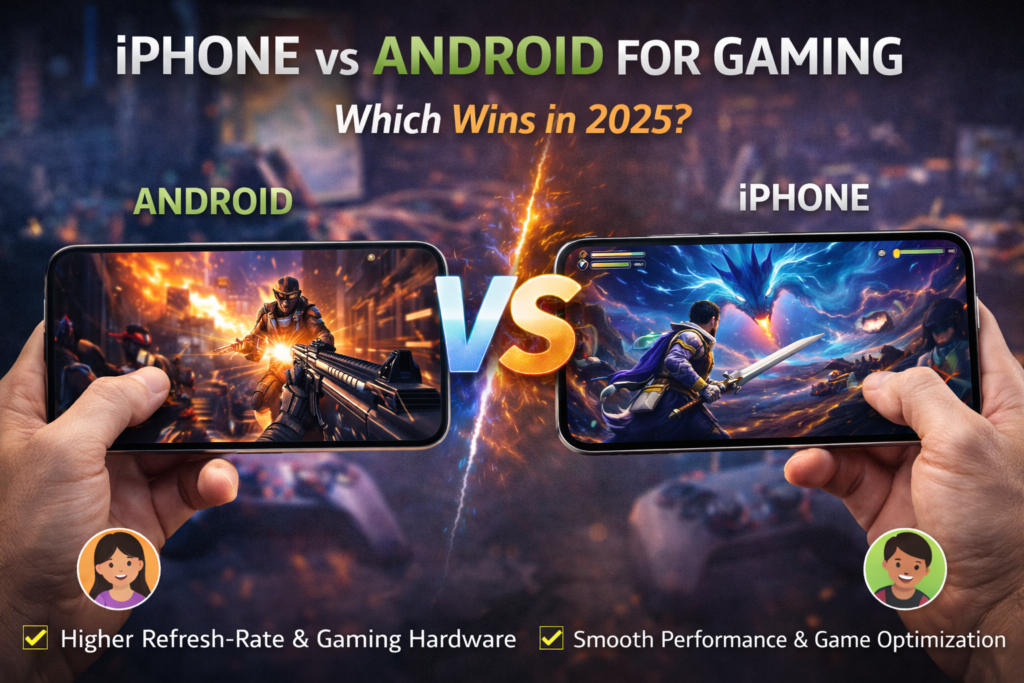
If you are wondering about iPhone vs Android for gaming, the real question is which phone gives you smoother gameplay, better performance, and more fun overall.
Both platforms can run popular games like Call of Duty Mobile and Genshin Impact, but they do it a little differently.
iPhones often deliver very smooth performance and strong game optimization, while Android phones offer more choices, including powerful gaming phones with high refresh-rate screens.
I’ve tested and used many smartphones for gaming over the years, and both can be great.
The best choice depends on whether you want raw performance, more device options, or the most flexible gaming experience.
Who This Is For
Why Your Phone Chip Matters for Gaming
I have tested and played games on both iPhones and Android phones for years.
And I can tell you — the chip inside your phone makes a bigger difference than most people think.
Mobile gaming has grown into something huge.
People play everything from quick puzzle games to full console-style titles like Genshin Impact and Call of Duty Mobile.
The phone you carry is now a serious gaming device.
But not all phones are built the same.
The chip handles everything — how smooth the game runs, how long the battery lasts, and whether your phone gets hot after ten minutes of play.
I will keep things simple.
Just the facts that actually matter when you’re deciding which phone to game on.
Confirmed chip specs come from Apple’s and Samsung’s official pages.
Chip Power: Apple Silicon vs Snapdragon 8 Elite
The chip is the engine of your phone.
For gaming, it controls how fast things load, how smooth the frame rate is, and whether visual effects look great or get turned off to save power.
Apple A19 Pro: What Apple Officially Confirms
According to Apple’s official iPhone 17 Pro spec page, the A19 Pro chip features a 6-core CPU, a 6-core GPU with Neural Accelerators, a 16-core Neural Engine, and hardware-accelerated ray tracing.
It is built on an advanced 3nm process.
Apple says its newest chips are designed to improve sustained performance and efficiency compared to previous generations.
That is a confirmed Apple claim — not an estimate.
Apple does not publicly confirm RAM figures for any iPhone.
Reports from analysts and teardown sources suggest the iPhone 17 Pro likely includes around 12GB of RAM, but this should be treated as unconfirmed until Apple or a verified teardown confirms it.
Early benchmark estimates from pre-release testing suggest the A19 Pro may score somewhere in the 3,800 to 4,000 range in Geekbench 6 single-core tests.
These are estimates — not confirmed retail figures.
What About the iPhone 17 and iPhone Air?
According to Apple’s official pages, the standard iPhone 17 uses the A19 chip with a 5-core GPU.
The iPhone 17 supports hardware ray tracing.
If Apple releases a thinner iPhone model in the future, it would likely use similar Apple Silicon and gaming features.
They’re strong gaming phones — the Pro models carry the extra GPU core for the most demanding titles.
Snapdragon 8 Elite for Galaxy: Confirmed Specs
The Samsung Galaxy S25 Ultra runs Qualcomm’s Snapdragon 8 Elite for Galaxy.
This chip peaks at around 4.47 GHz on its top CPU cores and uses the Adreno 830 GPU.
It is also built on a 3nm process.
These specs are confirmed from Samsung’s official listings and GSMArena.
In confirmed Geekbench 6 retail testing, the S25 Ultra scores around 3,106 in single-core and 9,763 in multi-core.
The multi-core score is competitive with Apple’s latest chips. Single-core performance — where Apple has historically led — is noticeably lower.
The “for Galaxy” version of the chip shows no meaningful difference from the standard Snapdragon 8 Elite in 3DMark GPU tests.
The real advantages of the S25 Ultra over the base S25 are its display and camera — not raw chip performance.
Many mobile games rely heavily on single-core performance, even though modern engines use multiple CPU cores.
| Chip | Phone | CPU | GPU | RAM | GB6 Single | GB6 Multi | Ray Tracing |
|---|---|---|---|---|---|---|---|
| Apple A19 Pro | iPhone 17 Pro / Pro Max | 6-core | 6-core | ~12GB (reports only) | ~3,800–4,000 (est.) | ~9,700+ (est.) | ✓ Yes |
| Apple A19 Pro | iPhone Air(reported) | 6-core | 5-core | ~8GB (reports only) | ~3,800–4,000 (est.) | ~9,700+ (est.) | ✓ Yes |
| Apple A19 | iPhone 17 | 6-core | 5-core | ~8GB (reports only) | ~3,400–3,600 (est.) | ~9,000+ (est.) | ✓ Yes |
| Snapdragon 8 Elite | Samsung Galaxy S25 Ultra | 8-core | Adreno 830 | 12GB confirmed | 3,106 confirmed | 9,763 confirmed | ✓ Yes |
| Google Tensor G4 | Google Pixel 9 Pro | 9-core | Mali-G715 | 16GB confirmed | ~1,900 confirmed | ~4,800–5,200 confirmed | ✗ No |
Apple benchmark scores are pre-release estimates. Apple does not publicly confirm RAM.
Samsung and Pixel scores are confirmed from retail testing.
Based on Apple’s official performance claims and early estimates, the A19 Pro is expected to lead on single-core speed.
Cooling: Does Your Phone Overheat Mid-Game?
Raw chip speed only tells half the story.
A fast chip that overheats and slows down is worse than a slightly slower chip that stays consistent.
This is called thermal throttling — and it ruins gaming sessions.
iPhone 17 Pro: Built for Sustained Performance
Apple says its newest chips are designed to improve sustained performance and efficiency compared to previous generations.
The word “sustained” is important — it means the chip is designed to hold its speed under heavy load, not just hit a quick peak and drop off.
Reports ahead of the iPhone 17 Pro’s launch suggested Apple made significant improvements to its thermal management system to support this sustained performance target.
Samsung Galaxy S25 Ultra: Better Than Before, But Throttles Under Load
Samsung confirmed the S25 Ultra uses a vapor chamber that is roughly 40% larger than the one in the Galaxy S24 Ultra.
That is a real and confirmed improvement.
However, some stress tests have shown the S25 Ultra’s GPU performance dropping during extended gaming sessions under heavy load.
This is common for flagship smartphones — they all throttle to protect themselves from overheating.
The S25 Ultra handles it better than last year’s model, but sustained GPU performance is still not on the same level as Apple’s latest chips based on available test data.
When a phone gets too hot, it slows the chip down automatically.
Apple’s confirmed sustained performance claim and improved thermal design give it the edge for long gaming sessions.
Display: Smooth Screens Make Better Games
A fast chip with a slow screen is like a sports car with square wheels.
The display is where all that chip power shows up — in smooth scrolling, sharp visuals, and fast response.
Both Platforms: 120Hz Is Standard at the Top
Apple usually reserves 120Hz ProMotion displays for Pro models, while standard iPhones often use 60Hz screens.
Samsung’s Galaxy S25 Ultra also runs 1–120Hz LTPO. Both adapt their refresh rate on the fly to save battery on static content and ramp up to 120Hz during fast gameplay.
At 120Hz, games feel noticeably more fluid. If you’ve never used a 120Hz phone before, the difference is genuinely impressive the first time you see it.
iPhone: Strong Touch Response
iPhones have historically shown strong touch latency in side-by-side tests, though the gap has narrowed significantly in recent flagship Android devices.
For fast games like fighting games, racing, or rhythm games, touch response still plays a role — and iPhone remains a strong performer here.
Android: More Options, Including 165Hz Gaming Phones
Android offers more display flexibility.
Dedicated gaming phones like the ASUS ROG Phone 9 Pro push refresh rates up to 165Hz — higher than any current iPhone.
This can give a small edge in very fast competitive games.
Samsung’s Galaxy S25 Ultra also uses a QHD+ panel — sharper than the iPhone 17 Pro’s display — making games look extra crisp when developers support the higher resolution.
For most games, 120Hz is more than enough.
Game Libraries: What Can You Actually Play?
Having a fast phone doesn’t matter if the games you want aren’t on it.
Let’s look at what you can actually play on each platform.
iOS App Store: Higher Revenue, Early Launches
Both the App Store and Google Play host hundreds of thousands of games.
iOS typically generates significantly more gaming revenue than Android, which encourages developers to prioritize iOS releases.
If you want to play new titles as soon as they drop, iPhone has a clear advantage.
Some games launch exclusively on iOS and never come to Android at all.
Apple Arcade: 200+ Games, No Ads, No Paywalls
Apple Arcade costs $6.99 per month.
It gives you 200+ games with zero ads and zero in-app purchases.
You pay once and play everything.
It covers up to 6 family members and works on iPhone, iPad, Mac, Apple TV, and Apple Vision Pro.
New Apple device purchases include 3 months free.
Google Play: More Freedom and Flexibility
Google Play hosts a very large game library — larger in total count than the App Store.
Google Play Pass offers a similar subscription at $4.99/month, including popular titles like Stardew Valley and Monument Valley 3.
Android’s real gaming advantage is freedom.
You can install emulators to play old console games.
You can sideload game stores like Epic Games Store.
For gamers who want no restrictions, Android is the more open platform.
| ✅ iPhone Gaming Strengths
• Games launch on iOS first — often weeks before Android • Apple Arcade: 200+ games, no ads, no in-app purchases • Higher developer revenue means better game quality overall • Lower touch latency for fast, competitive games |
❌ iPhone Gaming Weaknesses
• No emulators for old console games (outside EU) • No sideloading game stores like Epic • Locked to App Store — less game flexibility overall • No dedicated gaming phone option in the iPhone lineup |
| ✅ Android Gaming Strengths
• A very large game library on Google Play • Emulators allowed — play retro console games • Sideload Epic Games Store and other game platforms • Dedicated gaming phones up to 165Hz (ASUS ROG Phone 9 Pro) |
❌ Android Gaming Weaknesses
• Many top games launch on iOS first • More inconsistent game optimization across Android devices • Higher malware risk from sideloaded game sources • GPU throttling on Samsung S25 Ultra under heavy load |
Controllers and Game Accessories
Touch controls are fine for casual games. But for serious gaming — racing, shooters, fighting games — a real controller makes everything better.
Both platforms support them well.
Both Platforms: PS5 and Xbox Controllers Work
Both iPhone and Android support the PlayStation 5 DualSense and Xbox Series X controller over Bluetooth.
Just hold the pairing button on the controller and connect through your Bluetooth settings.
No apps, no cables, no extra steps needed on either platform.
iPhone: MFi Controllers Add Extra Features
iPhone supports MFi (Made for iPhone) certified game controllers. Brands like Backbone and Razer make popular MFi controllers with built-in phone clips that turn your iPhone into a handheld console experience.
Android: More Accessory Variety
Android supports a wider range of controllers and accessories. You can use any USB-C wired controller, almost any Bluetooth gamepad, and gaming grips from brands like GameSir and ASUS.
Android gaming phones often come with official clip accessories designed specifically for the device.
Both platforms handle PS5 and Xbox controllers perfectly.
Budget Gaming: What Do You Get for Less?
Not everyone is spending $1,000+ on a phone. Here’s how each platform stacks up at lower price points.
iPhone 16 and iPhone SE: Apple’s More Affordable Options
The iPhone 16 starts at $699 and runs on the A18 chip with a 5-core GPU.
It’s a very capable gaming phone for its price.
The next-generation iPhone SE is expected to use Apple’s newer chips, though Apple has not officially confirmed its specifications yet.
Android Mid-Range: More Gaming Hardware for Less
Android mid-range phones often offer more gaming hardware per dollar.
The Samsung Galaxy A35 5G at around $399 has a 120Hz Super AMOLED display — smooth enough for most games, and at a lower price than Apple’s comparable options.
The Google Pixel 8a at around $499 and the OnePlus 12R at around $499 both offer strong gaming performance at mid-range prices.
Android gives you more gaming hardware per dollar in the $400–$600 range.
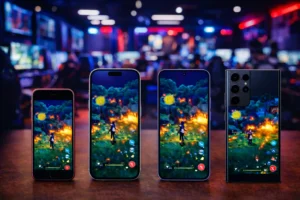
Below $600, Android gives you more gaming hardware per dollar — especially on display refresh rate.
Full Gaming Comparison Table
Here’s every major gaming factor in one place.
Apple benchmark scores are pre-release estimates — Samsung and Pixel scores are confirmed from retail testing.
| Gaming Feature | iPhone 17 Pro Max | Samsung Galaxy S25 Ultra | Google Pixel 9 Pro |
|---|---|---|---|
| Chip | A19 Pro — 6-core CPU, 6-core GPU | Snapdragon 8 Elite — Adreno 830 | Google Tensor G4 |
| RAM | ~12GB (reports — Apple unconfirmed) | 12GB confirmed | 16GB confirmed |
| Single-core score | ~3,800–4,000 (pre-release est.) | 3,106 confirmed | ~1,900 confirmed |
| Multi-core score | ~9,700+ (pre-release est.) | 9,763 confirmed | ~4,800–5,200 confirmed |
| Hardware Ray Tracing | ✓ Yes (Apple official) | ✓ Yes | ✗ No |
| Refresh Rate | 1–120Hz ProMotion | 1–120Hz LTPO | 1–120Hz LTPO |
| Cooling | Improved thermal system (reports) | Vapor chamber — 40% larger than S24 | Standard smartphone cooling |
| Sustained performance | Up to 40% better than A18 Pro (Apple official) | Some throttling under heavy load | Drops under heavy load |
| Game library | Hundreds of thousands — early launches | Very large — Google Play Store | Very large — Google Play Store |
| Gaming subscription | Apple Arcade $6.99/mo — 200+ games | Google Play Pass $4.99/mo | Google Play Pass $4.99/mo |
| Emulators allowed | No (EU exception) | Yes | Yes |
| Controller support | PS5, Xbox, MFi | PS5, Xbox, USB-C, Bluetooth | PS5, Xbox, USB-C, Bluetooth |
| Touch response | Historically strong — gap narrowing | Strong | Strong |
| Starting price | $1,199 | $1,299 | $999 |
Which Phone Wins for Gaming?
For raw performance: iPhone 17 Pro wins
Apple’s A19 Pro is built for sustained performance.
Apple officially claims up to 40% better sustained speed than the A18 Pro.
Early benchmark estimates put single-core performance well ahead of the Snapdragon 8 Elite.
For pure power in demanding games, the A19 Pro is expected to be one of the fastest mobile chips available.
For game variety and freedom: Android wins
Android has a very large game library, supports emulators, and lets you install game stores like Epic.
If you want to play retro games, access the widest selection, or use any controller — Android gives you more freedom.
For budget gaming: Android gives better value
Below $600, Android phones give you more gaming hardware per dollar.
A 120Hz display on a $399 Android phone beats the 60Hz screen on the iPhone SE for gaming smoothness.
For serious and competitive gaming: iPhone 17 Pro
Strong touch response, better sustained chip performance, early game launches, and the most powerful mobile chip available.
If gaming performance is your top priority, the iPhone 17 Pro is likely one of the strongest options.
iPhone vs Android for Gaming — Winner: iPhone 17 Pro, for performance
Apple’s A19 Pro is expected to lead on single-core speed and sustained gaming performance.
iPhones also get games first and offer strong touch response.
Android wins on freedom — emulators, more game stores, dedicated gaming phones, and better value below $600.
Your choice comes down to what matters more: raw power or maximum flexibility.
| ✅ Pick iPhone If…
• You want the fastest chip for demanding games • You play competitive or fast-paced games where latency matters • You want games to launch on your platform first • You love Apple Arcade’s ad-free, no-paywall experience |
✅ Pick Android If…
• You want to play retro games via emulators • You want more game stores and sideloading freedom • You’re on a budget — better gaming hardware for less • You want a dedicated gaming phone with 165Hz display |
FAQs
Is iPhone or Android better for gaming?
iPhone wins on raw chip speed and game optimization. The A19 Pro in the iPhone 17 Pro scores 25% higher than Snapdragon 8 Elite in single-core tests — which matters most for games. Android wins on flexibility — emulators, more game stores, and dedicated gaming phones up to 165Hz.
What is Apple Arcade?
Apple Arcade costs $6.99 per month and gives you 200+ games with no ads and no in-app purchases. It works on iPhone, iPad, Mac, Apple TV, and Apple Vision Pro. New Apple device purchases include 3 months free.
Do Android phones overheat while gaming?
Some do. Some stress tests show performance drops during long gaming sessions due to thermal throttling. The iPhone 17 Pro’s vapor chamber cooling keeps performance more consistent. Dedicated Android gaming phones like the ASUS ROG Phone 9 Pro handle heat much better than standard flagship Androids.
Can you use a PS5 or Xbox controller with iPhone and Android?
Yes — both platforms support PS5 DualSense and Xbox Series X controllers over Bluetooth. Just hold the pairing button on the controller and connect through your phone’s Bluetooth settings. No extra apps or cables needed on either platform.