Looking for the best phone in 2026? The Samsung Galaxy S25 Ultra and iPhone 16 Pro Max are two of the top choices right now.
Both are powerful, but they suit different kinds of users.
Choosing the right phone can make a big difference in your daily life.
The Samsung Galaxy S25 Ultra is made for people who love features.
It has a strong zoom for amazing photos, super-fast charging, and the S Pen for writing, drawing, or work tasks.
You can do more and control more with Samsung’s tools.
The iPhone 16 Pro Max is built for simplicity and smooth performance.
It has a long-lasting battery, great video quality, and works easily with other Apple devices like Macs, iPads, and AirPods.
iPhone focuses on speed, reliability, and a clean, easy-to-use experience.
In this guide, I will compare the S25 Ultra and iPhone 16 Pro Max side by side.
You will learn about cameras, battery life, performance, design, and extra features.
By the end, you will know which phone fits your life better, without confusion.
Whether you care about fast charging, amazing photos, smooth performance, or long battery life, this post will help you make a smart choice.
1. Quick Specs Comparison
| Spec | Samsung Galaxy S25 Ultra | iPhone 16 Pro Max |
|---|---|---|
| Released | February 7, 2025 | September 20, 2024 |
| Chip | Snapdragon 8 Elite for Galaxy (3nm) | Apple A18 Pro (3nm) |
| RAM | 12GB (some regional configurations may vary) | 8GB |
| Display | 6.9-inch AMOLED, 1440×3120, 120Hz | 6.9-inch OLED, 1320×2868, 120Hz |
| Peak brightness | 2,600 nits (claimed) | 2,000 nits (claimed) |
| Battery | 5,000mAh | 4,685mAh (widely reported — Apple does not list mAh on its main specs page) |
| Wired charging | 45W | Up to 50% in around 30 min with a 20W adapter or higher |
| Wireless charging | 15W (no built-in magnets) | 25W MagSafe (built-in magnets) |
| Main camera | 200MP (f/1.7) | 48MP Fusion (f/1.78) |
| Ultrawide | 50MP | 48MP |
| Telephoto | 50MP 5x + 10MP 3x | 12MP 5x |
| Weight | 218g | 227g |
| Thickness | 8.2mm | 8.3mm |
| Frame material | Titanium | Titanium |
| Water resistance | IP68 | IP68 |
| S Pen | Yes (no Bluetooth) | No |
| Camera Control | No | Yes |
| OS updates | 7 years (Samsung official promise) | Long-term support — no matching fixed 7-year commitment stated |
| Storage options | 256GB / 512GB / 1TB | 256GB / 512GB / 1TB |
| Starting price (US) | $1,299 | $1,199 |
2. Design & Build Quality
Both phones use titanium frames — so the “titanium vs aluminum” debate does not apply here.
Both feel premium and cold to the touch, both are reassuringly solid.
Weight and Grip
The S25 Ultra weighs 218g and the iPhone 16 Pro Max weighs 227g.
That 9g difference sounds small on paper, but some users may notice it during long sessions.
The S25 Ultra may feel slightly easier to manage in one hand because it is a bit lighter.
Neither phone is truly one-hand friendly at 6.9 inches — but the S25 Ultra is the slightly easier option.
The grip experience is also different. The S25 Ultra has flat sides and a slot for the S Pen on the bottom.
The iPhone has Apple’s Camera Control button on the right side — a small raised ridge that becomes very useful once you get used to it.
Which one feels better in your hand is personal, but some users may find the iPhone 16 Pro Max slightly wider and bulkier to grip.
Design Changes in the S25 Ultra
Samsung made a controversial call with the S25 Ultra — they removed the squared-off corners that defined the S24 Ultra and earlier Ultra models, giving the phone a more rounded shape that looks a lot like the iPhone.
Long-time Samsung fans were split on this.
The phone is undeniably more comfortable to hold, but it lost a visual identity that set it apart.
Durability
Both phones carry an IP68 water resistance rating, but not at the same tested depth.
The iPhone 16 Pro Max is rated for up to 6 meters for 30 minutes, while the Galaxy S25 Ultra is rated for up to 1.5 meters for 30 minutes.
The S25 Ultra uses Corning Gorilla Armor 2 on the front, which adds anti-reflective coating on top of the scratch resistance.
The iPhone 16 Pro Max uses Apple’s Ceramic Shield — Apple claims it is 2x tougher than any other glass on a smartphone. Both are durable. Both will crack if you drop them from height.
3. Display Comparison
Both screens are 6.9 inches and both run at 1 to 120Hz adaptive refresh rate.
The specs look similar.
But the actual experience is more interesting.
Brightness — The Surprising Result
Samsung claims 2,600 nits peak brightness for the S25 Ultra and Apple claims 2,000 nits for the iPhone 16 Pro Max.
You would assume Samsung is brighter.
In some lab tests (including GSMArena), the iPhone 16 Pro Max measured brighter…
In manual mode, iPhone measured 900 nits versus 784 nits for the S25 Ultra.
|
Why Samsung May Be Easier to Read Outdoors
|
| Samsung’s anti-reflective display treatment can make the S25 Ultra easier to read outdoors, even though the iPhone measures brighter in lab testing. |
| Tom’s Guide found the S25 Ultra easier to read outdoors, while lab brightness results vary by test source. |
Color and Resolution
The S25 Ultra has a higher resolution at 1440×3120 compared to the iPhone’s 1320×2868 — both are sharp enough that you will not see individual pixels at normal viewing distance.
For color accuracy, iPhone tends to look more natural and true-to-life out of the box.
The S25 Ultra is more vivid and punchy by default — which many people prefer — but you can adjust both to your taste.
The S25 Ultra has an Always-On Display that shows time and notifications at all times.
The iPhone 16 Pro Max also has Always-On, but Apple’s version drops to 1 nit in the dark to save power — significantly better for overnight battery drain.
4. Performance & Gaming
Both phones use 3nm chips and both are fast enough for everything you will ever throw at them.
But there are meaningful differences under the surface.
Benchmark Results
In Geekbench 6 multi-core tests, the S25 Ultra generally scores higher than the iPhone 16 Pro Max
Single-core performance goes to iPhone, which tends to have better single-threaded speed that matters in many everyday tasks.
In some GPU benchmarks, Samsung shows stronger peak performance.
Real-World Speed
In day-to-day use, both phones feel identical.
Apps open instantly. Multitasking is smooth.
The performance gap only shows up in sustained heavy workloads — video editing, 3D rendering, or long gaming sessions.
Thermal Throttling
the S25 Ultra can run warmer under sustained load.
Samsung fitted the S25 Ultra with a vapor chamber that is 40% larger than the one in the S24 Ultra, with extra thermal interface materials — and it helps.
But the iPhone 16 Pro Max still manages sustained performance slightly better under heat.
Apple claims a 20% improvement in sustained gaming performance over the A17 Pro, and independent tests confirm the iPhone maintains frame rates more consistently during long sessions.
Gaming — PUBG, COD Mobile, Genshin Impact
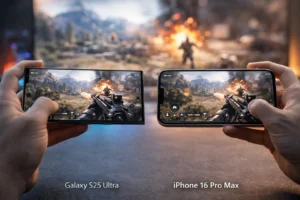
Both phones handle PUBG Mobile and Call of Duty Mobile at maximum graphics settings without any issues.
In Genshin Impact at maximum quality — the most demanding mainstream mobile game — both phones can run it, but the S25 Ultra’s larger GPU scores give it a slight edge in sustained frame rates during prolonged play.
The iPhone tends to have smoother individual frame timing, which matters for competitive shooters like COD.
For most gamers, both are excellent — but the S25 Ultra edges it for GPU-heavy titles and the iPhone edges it for competitive shooters.
7-Year Update Promise — What It Actually Means
Samsung publicly promises 7 years of OS and security updates for the Galaxy S25 Ultra.
Apple has a strong long-term support track record, but does not publish the same fixed 7-year commitment for the iPhone 16 Pro Max.
If you buy the S25 Ultra today and keep it for 4 years, you are well within Samsung’s update window.
For Samsung, a 7-year promise on a phone bought in 2025 means support through 2032.
5. Camera Comparison
This is the section most people are here for.
Both phones are excellent cameras — but they are excellent in different ways.
The Camera Systems
The S25 Ultra has four rear cameras: a 200MP main, a 50MP ultrawide, a 50MP 5x telephoto, and a 10MP 3x telephoto.
The iPhone 16 Pro Max has three: a 48MP Fusion main, a 48MP ultrawide, and a 12MP 5x telephoto.
Samsung gives you more options.
iPhone gives you a more refined experience.
Daylight Photos
In good light, both phones produce stunning images.
The S25 Ultra captures more raw detail at 200MP — you can crop in heavily and still have a usable image.
The iPhone tends to produce more natural, accurate color — skin tones look more lifelike and scenes look closer to what your eyes actually see.
Which you prefer comes down to taste: Samsung gives you more punch and detail, iPhone gives you more accuracy.
Night Photos
The iPhone 16 Pro Max generally has the edge in low-light photography.
It often produces less noise, better color in dark scenes, and more consistent results without the processing artifacts that Samsung’s aggressive computational photography can sometimes introduce.
If you shoot a lot of indoor or evening photos, iPhone has the edge.
Zoom Photography
The S25 Ultra has the more versatile zoom system. Having both a 3x and a 5x telephoto means you have more options for mid-range zoom shots.
At 10x and beyond — Space Zoom up to 100x — the S25 Ultra is in a different league.
For travel photography, sports, and wildlife, Samsung is the better zoom phone.
| The S25 Ultra’s Weak Link — The 3x Telephoto |
| The 10MP 3x telephoto sensor on the S25 Ultra is the same ageing sensor from previous models. |
| It struggles in low light at 3x zoom — where the iPhone actually pulls ahead. |
| In good daylight at 3x it is fine, but do not expect the same quality as the 5x or main sensor. |
Video
The iPhone 16 Pro Max generally has the edge in video.
The combination of 4K at 120fps in Dolby Vision, excellent optical image stabilization, and Apple’s audio processing through its studio-quality microphones makes it one of the best video cameras on the market.
Content creators and anyone shooting Reels, TikTok, or YouTube videos will get better results from the iPhone.
Social Media Output
For zoom-heavy social shots, Samsung has the stronger setup.
For TikTok, Reels, and YouTube video — iPhone. Both produce images that look great on every social platform.
Camera Control Button (iPhone Only)
The Camera Control is a dedicated button on the right side of the iPhone 16 Pro Max.
A single press opens the camera. A swipe adjusts zoom. Another swipe adjusts exposure.
It sounds simple, but once you use it, going back to opening the camera app manually feels slow.
It is one of the best things Apple added to the iPhone 16 Pro Max.
6. Battery Life Test — Morning to Night
The S25 Ultra has a 5,000mAh battery, and the iPhone is widely reported at 4,685mAh — though Apple’s published information focuses more on battery-life claims than headline mAh capacity.
The Galaxy S25 Ultra delivers strong performance and a larger battery, while the iPhone 16 Pro Max focuses on efficiency and smooth optimization.
For a full breakdown of hardware specifications, check the detailed specs on GSMArena.
Samsung’s battery is bigger.
In published battery tests, the iPhone 16 Pro Max still comes out slightly ahead overall.
What the Tests Show
In one real-world PhoneBuff test, the iPhone 16 Pro Max lasted 28 hours and 1 minute.
The S25 Ultra lasted 27 hours and 50 minutes.
The gap was just 11 minutes. Remarkably close.
Morning to Night Simulation
For a typical user: morning social media, 2 hours video streaming, 1 hour gaming, 45 minutes camera use, standby and calls, evening browsing.
Both phones reach end of day with 28–40% remaining.
iPhone does better in web browsing and video playback tests (GSMArena).
S25 Ultra does better in voice calls. Gaming is virtually identical.
| The Real Battery Story |
| Both phones comfortably last a full day. The 11-minute gap in the real-world test is negligible. |
| iPhone does better in web browsing and video. S25 Ultra does better in voice calls. |
| The headline: far closer than the battery size difference would suggest. |
7. Charging Speed
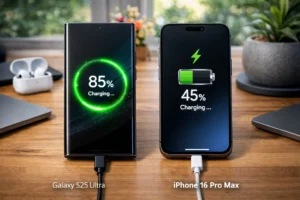
This is where Samsung wins clearly — and it is a bigger deal than most reviews let on.
Wired Charging
The S25 Ultra supports 45W wired charging.
In testing by Tom’s Guide, it reached around 71% in 30 minutes
TechRadar measured 65% in 30 minutes.
Apple says the iPhone 16 Pro Max can reach up to 50% in around 30 minutes with a 20W adapter or higher.
In Tom’s Guide testing, it reached around 50–55% in 30 minutes.
To charge fully from empty: S25 Ultra takes around 60 minutes.
iPhone 16 Pro Max takes closer to 75 to 80 minutes.
That is a meaningful gap for someone in a rush.
If you regularly need a quick top-up before leaving the house, Samsung charges noticeably faster.
Wireless Charging
This is where iPhone wins back some ground.
The iPhone 16 Pro Max has built-in MagSafe magnets — it snaps onto any MagSafe or Qi2 pad instantly and reaches around 18W in real-world testing (Apple officially claims up to 25W, though real-world speeds are often lower).
The S25 Ultra does not have any built-in magnets.
You need to buy a magnetic case to use it with Qi2 accessories.
Without that case, the S25 Ultra charges wirelessly at around 15W.
You can read more about how wireless charging works in our guide on phone connectivity issues.
Heat While Charging
The S25 Ultra runs warmer during wired charging at 45W — this is normal for higher-wattage input.
The iPhone charges cooler because the lower wattage generates less heat.
Both phones have battery protection systems that slow charging above 80% to reduce wear.
Neither phone includes a charger in the box — both come with a USB-C cable only.
Charging While Gaming
If you plug in and game at the same time, charging slows on both phones because the processor and charger both generate heat.
The S25 Ultra slows more noticeably under this scenario — both inputs are generating heat simultaneously at higher levels.
For fastest charging, screen off and phone idle wins every time on both devices.
For more on how charging affects your phone’s performance, see our guide on why phones switch off automatically.
8. Software & Ecosystem
This is the section that actually decides which phone you should buy — more than any spec or camera result.
Android Freedom vs Apple Continuity
The S25 Ultra launched with Android 15 and Samsung’s One UI 7, with newer One UI versions rolling out over time depending on region and update status.
Android gives you genuine freedom — you can change your default apps, sideload software, customize the interface deeply, and transfer files without needing any proprietary software.
Samsung’s One UI software is clean and refined with good customization options.
The iPhone 16 Pro Max runs iOS 18. iOS is tighter and more controlled — but for many people that control is the point.
Many major apps tend to be more consistently optimized on iOS, updates roll out simultaneously to all users, and the system tends to feel smoother in everyday use because Apple controls both the hardware and the software.
The Ecosystem — What You Actually Lose By Switching
If you own a MacBook, switching to Samsung will cost you: AirDrop (instant wireless file sharing), iMessage on Mac, Handoff (start something on iPhone, finish it on Mac), Universal Clipboard (copy on iPhone, paste on Mac), seamless Apple Watch pairing, and FaceTime from your computer.
These are not just features — they are daily habits for MacBook users. Losing them is genuinely disruptive.
If you own a Windows laptop, you have much less to lose.
Samsung’s Link to Windows works well, Google services integrate smoothly across devices, and the S25 Ultra’s DeX mode can replace a laptop entirely for basic tasks on the road.
| The Real Deciding Factor |
| If you own a MacBook — buy the iPhone 16 Pro Max if you rely heavily on AirDrop, Handoff, iMessage on Mac, and Universal Clipboard. |
| If you own a Windows laptop — the S25 Ultra is the better phone overall. |
| Your laptop is the deciding factor. More than any camera score or benchmark. |
9. AI Features Comparison
AI is now a core part of both phones — and this is one of the fastest-moving areas in mobile technology.
Galaxy AI (S25 Ultra)
The S25 Ultra runs Galaxy AI powered by Google Gemini.
The cross-app intelligence is one of Samsung’s strongest software advantages.
You can say “Text Mike the Oscars date and add it to my calendar” and the phone handles both tasks at once — finding the date, sending the message, and creating the calendar event.
No tapping between apps.
Circle to Search lets you draw a circle around anything on your screen — an object, text, or image — and instantly search for it on Google without opening a browser.
This is something people miss when they switch away from Samsung.
Apple Intelligence (iPhone 16 Pro Max)
Apple Intelligence on iOS 18 is more private-first — most processing happens on the device.
Siri got meaningful improvements, but Apple was honest that some features were still rolling out after launch.
By early 2026, Apple Intelligence had expanded beyond its launch state, though feature availability still varied by region, language, and software version.
At launch, Galaxy AI generally felt more feature-complete than Apple Intelligence.
Photo Editing AI
Samsung’s Generative Edit lets you remove objects, move subjects, and fill backgrounds convincingly.
Apple’s Clean Up tool does the same basic task.
Both work well for removing unwanted objects from photos — Samsung’s implementation is slightly more powerful, Apple’s is simpler to use.
On-Device Privacy
Both phones process AI tasks on-device for sensitive operations to protect your privacy.
Apple has been more transparent about this model. Samsung uses both on-device and cloud AI depending on the task.
10. Storage & Pricing
| Storage | Samsung S25 Ultra | iPhone 16 Pro Max |
|---|---|---|
| 256GB | $1,299 | $1,199 |
| 512GB | $1,419 | $1,399 |
| 1TB | $1,659 | $1,599 |
At every storage tier, the iPhone 16 Pro Max is $100 cheaper in the US.
However, Samsung regularly offered strong launch trade-in deals — in some cases up to $900 off with a trade-in — which could make the S25 Ultra better value depending on timing.
For resale value, Apple iPhones historically hold their value better over 2 to 3 years.
If you plan to sell in 18 months and upgrade, iPhone tends to retain more of its original price.
11. S Pen & Special Features
S Pen — What It Can and Cannot Do in 2026
The S Pen is built-in on the S25 Ultra.
Pressure-sensitive, perfect for handwritten notes, signing documents, annotating screenshots, and drawing.
No equivalent on iPhone.
| S Pen Lost Bluetooth in the S25 Ultra |
| The S Pen had Bluetooth since the Galaxy Note 9 in 2018. With Bluetooth, it worked as: |
| • A remote camera shutter — photograph yourself from a distance |
| • A presentation clicker — scroll slides without touching your phone |
| • A media remote — play/pause, skip tracks |
| These were called Air Actions. The S Pen on the S25 Ultra no longer supports these Bluetooth features. |
| If you used S Pen as a remote shutter or slide controller — you will miss this. |
| If you only used it for writing and drawing — you will not notice the difference. |
Samsung DeX — The Laptop Replacement
Plug the S25 Ultra into an external monitor or TV via USB-C and it switches into DeX mode — a full desktop-like interface with a taskbar, resizable windows, and keyboard and mouse support.
For business users and travelers, this is remarkable: one device replaces both your phone and a laptop for meetings, presentations, and documents.
The iPhone has no direct equivalent to the combination of S Pen input and Samsung DeX.
iPhone Camera Control
The Camera Control is a dedicated button on the right edge of the iPhone 16 Pro Max.
Press it once to open the camera. Slide your finger to zoom. Slide again to adjust exposure or depth.
It is tactile, fast, and intuitive — especially for quick shots where fumbling to tap the screen loses the moment. Photographers will love it.
MagSafe Ecosystem
The iPhone 16 Pro Max has built-in MagSafe magnets.
This means any MagSafe accessory — wallets, battery packs, desk mounts, car mounts — snaps on and off instantly and stays in place.
The accessory ecosystem is massive.
The S25 Ultra has no built-in magnets — you need a compatible case to use Qi2 accessories magnetically.
12. Extra Human Details — What Big Sites Miss
Real Pocket Comfort
The S25 Ultra is 8.2mm thick and 218g. The iPhone is 8.3mm and 227g.
In slim trouser pockets, the S25 Ultra slides in and out more easily.
In jeans, both are tight — these are large phones and no amount of spec comparison changes that.
If you wear slim-fit clothes regularly, this is worth thinking about.
One-Hand Usage
Neither phone is genuinely one-hand friendly. Both are 6.9 inches.
The S25 Ultra is lighter by 9g, which helps during longer sessions — holding your phone up to read or browse for 20+ minutes may feel less tiring.
Both have one-handed mode options in software that shrink the screen to a reachable area.
Sun Heat Performance
In hot climates, direct sunlight heats up both phone screens.
The S25 Ultra’s anti-reflective coating can make the screen easier to read outdoors at lower brightness settings in some conditions.
In practice, some users may find the S25 Ultra easier to use in bright outdoor conditions.
Speaker Quality
Both phones have stereo speakers and both score in the “Very Good” category in GSMArena’s loudness testing — virtually identical scores.
But the iPhone 16 Pro Max may sound better to many listeners. It has more natural audio — clearer mids, less harsh treble, and a more open soundstage.
If you regularly watch videos, listen to music, or make speaker calls without headphones, you will notice the difference.
Charging While Gaming
Both phones charge more slowly when gaming.
The S25 Ultra is more affected because 45W input and a hot processor together generate significant heat, triggering thermal throttling on both the charging speed and performance.
The iPhone may manage this more gracefully because its charging setup generates less heat in practice.
For fastest charging on either phone: screen off, airplane mode on, phone face-down in a cool place.
13. Head-to-Head Comparison Table
| Category | Samsung S25 Ultra | iPhone 16 Pro Max | Winner |
|---|---|---|---|
| Display resolution | 1440×3120 AMOLED | 1320×2868 OLED | Samsung |
| Outdoor visibility | Anti-reflective Gorilla Armor 2 | Brighter in lab testing (1796 vs 1417 nits auto) | Mixed — Samsung for glare, iPhone for brightness |
| Single-core speed | Good | ~15% faster | iPhone |
| Multi-core speed | 9,413 Geekbench 6 | 8,387 Geekbench 6 | Samsung |
| Gaming performance | Better GPU-heavy loads | Better frame consistency | Tie — depends on game type |
| Thermal control | Warm under load | Better sustained performance | iPhone |
| Zoom camera | Dual telephoto, 10x, 100x Space Zoom | Single 5x telephoto | Samsung |
| Night photography | Good | Better noise control | iPhone |
| Video quality | Good | 4K 120fps Dolby Vision, better audio | iPhone |
| Battery life | 27h 50min (PhoneBuff) | 28h 1min (PhoneBuff) | iPhone |
| Wired charging speed | 45W, 71% in 30 min | About 55% in 30 min (Tom’s Guide) | Samsung |
| Wireless charging | 15W, no built-in magnets | 18W MagSafe, built-in magnets | iPhone |
| Speakers | Very Good loudness | Very Good + more natural sound | iPhone |
| Weight | 218g | 227g | Samsung |
| S Pen | Yes (no Bluetooth) | No | Samsung |
| Camera Control | No | Yes | iPhone |
| DeX mode | Yes | No | Samsung |
| MagSafe ecosystem | No built-in magnets | Yes, built-in | iPhone |
| AI features (at launch) | Galaxy AI — more polished | Apple Intelligence — catching up | Samsung |
| Entry price | $1,299 | $1,199 | iPhone |
14. Pros & Cons
Samsung Galaxy S25 Ultra
| ✅ Pros |
| 45W wired charging — 71% in 30 minutes |
| S Pen built-in — notes, drawing, signing, precision control |
| More versatile zoom camera with dual telephoto system |
| Higher resolution anti-reflective display |
| DeX mode turns the phone into a desktop computer |
| Galaxy AI cross-app actions — a genuine productivity advantage |
| More RAM (12GB standard) for heavy multitasking |
| Lighter and slightly thinner than iPhone (218g vs 227g) |
| ❌ Cons |
| $100 more expensive at every storage tier |
| S Pen lost Bluetooth — no more Air Actions remote control |
| No built-in magnets — needs case for Qi2 magnetic accessories |
| 10MP 3x telephoto sensor is ageing and weak in low light |
| Runs warmer under load and during fast charging |
| Shorter battery life than iPhone despite larger battery |
Apple iPhone 16 Pro Max
| ✅ Pros |
| Slightly better battery life in published tests despite the smaller reported battery |
| One of the strongest video cameras in a phone — 4K 120fps Dolby Vision |
| Generally stronger portrait photography and low-light consistency |
| MagSafe built-in — massive accessories ecosystem |
| Camera Control button for fast, tactile shooting |
| Better speakers — cleaner, more natural sound |
| Better sustained thermal performance under load |
| $100 cheaper at every storage tier |
| Better resale value over 2–3 years |
| ❌ Cons |
| Slower wired charging — 55% in 30 minutes vs Samsung’s 71% |
| No S Pen |
| No DeX mode |
| Weaker zoom — single 5x telephoto only |
| Heavier than S25 Ultra (227g vs 218g) |
| Apple Intelligence behind Galaxy AI at launch |
15. Who Should Buy Which?
- Gamer — S25 Ultra — better multi-core and GPU benchmarks, sustained frame rates in Genshin Impact and COD Mobile
- Creator / Photographer — Depends — iPhone for video and portraits, S25 Ultra for zoom and landscape Instagram shots
- Traveller — Lean S25 Ultra if you value faster charging for quick top-ups, DeX for working on the road, and S Pen for notes
- Student — iPhone — $100 cheaper, better resale value, MagSafe accessories, simpler long-term iOS experience
- Business user — S25 Ultra — DeX mode for presentations, S Pen for notes, Galaxy AI cross-app productivity
- MacBook owner — Lean iPhone 16 Pro Max if you rely heavily on AirDrop, Handoff, iMessage on Mac, and other Apple ecosystem features.
- Windows laptop user — Lean S25 Ultra if you use a Windows laptop — it works better with Link to Windows, Google services, and has lower switching friction.
- Video creator — Lean iPhone 16 Pro Max for video work: 4K 120fps Dolby Vision, strong stabilization, and excellent audio capture.
16. Climate Tips
Hot and Sunny Climates — GCC, South Asia, Sub-Saharan Africa
The S25 Ultra’s anti-reflective display treatment may be especially helpful in regions with intense sunlight.
You can often read the screen at lower brightness settings, which may reduce battery consumption.
Tom’s Guide found the S25 Ultra appeared easier to read outdoors in direct sunlight, even though the iPhone measured brighter in lab conditions.
Hot and Humid Climates — Southeast Asia, Coastal Regions
Both phones are IP68 rated and handle humidity well.
The iPhone may have a slight endurance advantage in some warm-weather use cases, though results will vary by workload and screen brightness settings.
Cold Climates — Northern Europe, Canada, Russia
Lithium-ion batteries lose capacity in cold weather.
The S25 Ultra’s larger 5,000mAh battery gives you more buffer when the cold eats into capacity.
Both phones will feel the cold — but Samsung’s larger battery means you start with more headroom.
Dusty Environments
In dusty environments — construction sites, dry markets, and desert areas — the anti-reflective coating on the S25 Ultra may reduce the visual impact of smudges and glare.
Whether this matters in practice depends on personal habits and how often you clean the screen.
Regional Pricing
In the US, iPhone is $100 cheaper at every tier.
In some other markets — the UK, parts of Europe, and Australia — pricing can flip depending on carrier deals and local taxes.
Samsung’s trade-in offers have historically been more aggressive at launch.
Always check local carrier pricing before assuming the US price gap applies in your market.
17. Frequently Asked Questions
Q1: Which is better overall — S25 Ultra or iPhone 16 Pro Max?
Neither phone has a clear overall winner. S25 Ultra wins zoom, charging, multi-core, S Pen, and display. iPhone wins video, portrait camera, battery efficiency, speakers, and ecosystem. The right choice depends on how you use your phone and which laptop you own.
Q2: Which phone has better battery life?
The iPhone 16 Pro Max edges out the S25 Ultra in most battery tests despite a smaller widely reported battery capacity. In a real-world PhoneBuff test, iPhone lasted 28 hours and 1 minute vs 27 hours and 50 minutes for the S25 Ultra — just 11 minutes apart. Both comfortably last a full day.
Q3: Which phone has the better camera?
S25 Ultra wins zoom with dual telephoto and Space Zoom up to 100x. iPhone 16 Pro Max generally has the edge for video (4K 120fps Dolby Vision), portrait shots, and low-light photography. For social media video — iPhone. For travel zoom photography — Samsung.
Q4: Should I switch from iPhone to Samsung S25 Ultra?
If you use a MacBook, switching costs you AirDrop, iMessage on Mac, Handoff, and Apple Watch integration — think carefully. If you use a Windows laptop, you have much less to lose, and the S25 Ultra is a genuinely excellent upgrade.
Q5: Is the S25 Ultra worth $100 more than the iPhone 16 Pro Max?
The extra $100 gets you the S Pen, faster wired charging, higher-resolution display, and DeX mode. If those features matter to your daily workflow, yes. If you prefer the Apple ecosystem, the iPhone at $1,199 offers better value.
Q6: Which phone is better for gaming?
S25 Ultra wins GPU-heavy titles like Genshin Impact with better multi-core scores. iPhone 16 Pro Max wins for competitive shooters with better single-core speed and more consistent frame timing. Both handle every game at maximum settings.
Q. Which phone is better in 2026 — S25 Ultra or iPhone 16 Pro Max?
It depends on your needs. Samsung offers better zoom, faster charging, and more features, while iPhone provides better video, battery efficiency, and ecosystem integration.
18. ✅ Final Verdict
| Charging winner: Samsung S25 Ultra — in Tom’s Guide testing, it reached 71% in 30 minutes, while the iPhone 16 Pro Max reached about 55% in the same time. |
| Zoom camera winner: Samsung S25 Ultra — dual telephoto and Space Zoom. iPhone is more limited beyond 5x zoom. |
| Video and portrait winner: iPhone 16 Pro Max — 4K 120fps Dolby Vision, better low-light portraits. One of the best video phones on the market. |
| Battery life winner: iPhone 16 Pro Max — by just 11 minutes in real-world testing. Remarkably close. |
| Speaker winner: iPhone 16 Pro Max — similar loudness, but sound that many users may find cleaner and more natural. |
| Productivity winner: Samsung S25 Ultra — S Pen, DeX mode, Galaxy AI cross-app actions. The iPhone has no direct equivalent to the combination of S Pen input and Samsung DeX. |
| Value winner: iPhone 16 Pro Max — $100 cheaper at every tier with better long-term resale value. |
Conclusion
After spending weeks with both phones, my honest take is this: the Samsung Galaxy S25 Ultra may be the more versatile choice if you are not in the Apple ecosystem.
The S Pen, DeX mode, faster charging, better zoom, and Galaxy AI all make it a genuinely more versatile device.
But the iPhone 16 Pro Max may be the better fit if you own a MacBook, shoot a lot of video, or simply want a phone that works smoothly and consistently without thinking about it.
The worst thing you can do is buy either of these phones because of a spec number.
Buy the one that fits how you actually live.
If you regularly need to sign documents, shoot far-away subjects, or work from a hotel room without a laptop, the S25 Ultra is likely the better fit.
If you value video quality, seamless Mac integration, and a simpler experience, the iPhone 16 Pro Max is likely the better fit.
You will not regret either choice.


- Buy S25 Ultra if: you want the S Pen, faster charging, better zoom, DeX, or you use a Windows laptop
- Buy iPhone 16 Pro Max if: you want the best video, the Apple ecosystem, MagSafe, better speakers, or you own a MacBook.