Quick Answer
- Samsung generally charges faster overall, particularly during the early and middle parts of the charging cycle.
- iPhone is slower but more controlled — lower wattage, more consistent temperature
- 5 to 10 minute top-up: Samsung usually adds more battery in a short time based on available test data.
- Overnight charging: both are fine — both reach 100% before morning
- Key numbers: S25 Ultra reaches around 60–72% in 30 minutes depending on conditions (GSMArena and similar tests)
- Full charge difference: Samsung can finish significantly sooner — sometimes close to an hour earlier in comparable tests.
1. Charging Specs at a Glance
| Spec | Samsung Galaxy S25 Ultra | iPhone 16 Pro Max |
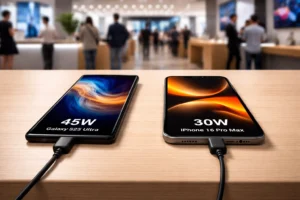
| Wired charging | 45W Super Fast Charging 2.0 | Apple says up to 50% in ~30 min with 20W+ adapter. Third-party tests show peak charging around ~25–30W briefly. |
| Wireless charging | up to around 15W wireless charging, with optimal alignment depending on compatible accessories. | up to 25W MagSafe (with compatible charger), ~15–18W in most real-world tests |
| 30-minute milestone | around 60–70% in some lab tests under ideal conditions | ~46-50% (ChargerLAB: 50% in 26 min, Apple official: ~50% in 30 min) |
| Full charge time | around 1 hour in faster lab results, though real-world times may vary | Full charge time: ~1h 45min–2h 10min in most tests (can reach ~2h 20min depending on conditions) |
| Charger in box | No — USB-C cable only | No — USB-C cable only |
| Battery protection | Adaptive Battery Protection (cap at 80-95%) | Optimized Charging (learns your routine) |
2. Real-World Charging Test Results
In most independent tests, the Samsung S25 Ultra charges noticeably faster during early and mid charging stages, with the overall trend favoring Samsung.
Here’s how several independent testing labs measured charging performance.
| GSMArena Lab — Wired Charging Results | ||
| S25 Ultra | 72% at 30 min | Full charge was reported at just under one hour in one lab setup, although results vary with chargers and temperature. |
| iPhone 16 Pro Max | 46% at 30 min | Full charge in 1 hour 57 minutes. ~27% at 15 minutes (GSMArena). |
TechDroider Test
| TechDroider — S25 Ultra Wired Milestones | ||
| 10 minutes | 17% | Strong early charging rate at 45W |
| 20 minutes | 40% | Consistent fast rate maintained |
| 30 minutes | 60% | Slightly lower than GSMArena — charger differences |
| 40 minutes | 80% | Still charging fast before taper |
| 57 minutes | 100% | Full charge confirmed |
ChargerLAB Independent Test
| ChargerLAB — Both Phones Wired Charging | ||
| S25 Ultra — 50% | 21 min | Tested with Samsung 65W charger. 80% at 37 min. |
| iPhone — 50% | 26 min | Tested with Apple 70W charger. 80% at 57 min. Full charge: 2h 20min. |
| Why Results Vary Between Labs |
| You may notice the S25 Ultra shows 60% at 30 min in one test and 72% in another. |
| Different chargers, cables, room temperatures, and background apps all affect charging speed. |
| The honest range for S25 Ultra at 30 minutes is 60-72% depending on conditions. |
| For iPhone it is 46-50%. All figures come from named lab tests. |
3. Which Charges Faster?
Samsung generally charges faster overall — this trend appears across multiple independent test results.
The S25 Ultra uses 45W wired charging.
Independent measurements suggest the iPhone typically peaks in the high-20W range, even when connected to higher-wattage adapters.
Think of it like filling a bucket — Samsung can be thought of as using a wider pipe, allowing the battery to fill faster in many tests.
iPhone charging is more controlled and consistent.
The temperature stays lower, the wattage drops off more gradually, and the results are more predictable across different chargers.
If you need the fastest possible charge, Samsung wins. If you want a more gentle, consistent charge, iPhone delivers that.
✅ Simple Verdict
Samsung S25 Ultra: faster at most charging milestones, especially early and mid-cycle.
iPhone 16 Pro Max: slower overall but more consistent — lower heat, steadier taper.
Both reach 100% overnight with no issues — overnight charging is fine on either phone.
4. 0–50% Charging — The Most Important Section
This is where most people care about speed.
You are not always charging from empty to full.
Most of the time you want to get from low battery to enough battery to go out the door.
The S25 Ultra reached 50% in 21 minutes in ChargerLAB’s test.
GSMArena recorded around 41% at the 15-minute mark, indicating very strong early charging performance.
Apple officially states the iPhone 16 Pro Max reaches up to 50% in around 30 minutes with a 20W or higher adapter.
ChargerLAB’s independent test confirmed 50% in 26 minutes.
Based on available test results, Samsung may reach the halfway point several minutes earlier in comparable conditions.
In the time it takes to brush your teeth and get dressed, Samsung adds around 30% and iPhone adds around 20%.
In everyday use, this kind of difference can be surprisingly noticeable during quick morning top-ups.
| Real-Life Context |
| You have 15 minutes before leaving the house. |
| Samsung goes from empty to around 41% (GSMArena). |
| iPhone goes from empty to around 27% (ChargerLAB). |
| That is 14 percentage points of extra battery from one rushed morning charge. |
5. Full Charge Time — 0–100%
The gap in full charge time is the biggest practical difference between these two phones on charging.
The S25 Ultra reaches a full charge in approximately 57 to 59 minutes across TechDroider and GSMArena’s tests.
The iPhone 16 Pro Max typically takes around 1 hour 45 minutes to 2 hours 10 minutes in most tests, though it can reach up to ~2 hours 20 minutes depending on charger and conditions.
One test from NotebookCheck showed 1 hour 45 minutes from 2% with a specific charger — so the honest range for iPhone is roughly 1 hour 45 minutes to 2 hours 20 minutes.
In many test scenarios, Samsung reaches a full charge significantly sooner — sometimes close to an hour earlier.
The iPhone tends to slow charging more aggressively after around 80%, which is part of Apple’s battery protection strategy.
This is by design — not a flaw. It helps the battery stay healthier for longer.
Neither phone includes a charger in the box. Both come with a USB-C cable only.
You need to buy a charger separately for either phone to reach these speeds.
6. Charging Milestones Table
Here is how both phones compare at each time milestone, based on data from GSMArena, TechDroider, and ChargerLAB.
| Time | Samsung S25 Ultra | iPhone 16 Pro Max | Gap |
|---|---|---|---|
| 10 minutes | ~17% TechDroider | ~10–14% (estimated from lab data) | Samsung ahead by roughly 3–7 percentage points |
| 15 minutes | ~41% GSMArena | ~27% (GSMArena) | Samsung +14% |
| 20 minutes | ~40–50% TechDroider / ChargerLAB | ~36% ChargerLAB | Samsung ahead |
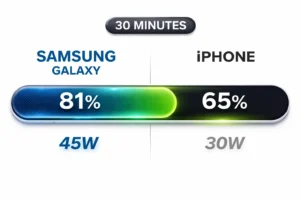
| 30 minutes | 60–72% GSMArena / TechDroider | ~46–50% GSMArena / ChargerLAB / Apple | Samsung +14–22% |
| 40 minutes | ~80% TechDroider | ~65% ChargerLAB est. | Samsung ahead |
| 57–60 minutes | ~100% TechDroider / GSMArena | ~80% ChargerLAB | Samsung full, iPhone at 80% |
| Full charge | ~57–59 min | ~1h 45min–2h 20min | Samsung can finish roughly 45–60 minutes sooner depending on conditions. |
All figures are from named lab tests.
Results may vary depending on charger wattage, cable type, ambient temperature, and background activity on the phone.
7. 5-Minute Quick Top-Up Test
A 5-minute charge is the real test of fast charging.
You are about to walk out the door and need a quick boost.
Which phone gives you more in that short window?
Short top-up tests suggest Samsung can add a visibly larger percentage during the first few minutes of charging.
For the iPhone at around 27 to 30W, a 5-minute charge adds approximately 5 to 7% based on charging curve estimates.
Samsung usually adds more in that short window — reflecting the higher charging wattage advantage.
At 10 minutes the gap is clearer still.
TechDroider showed the S25 Ultra at approximately 17% from empty at the 10-minute mark.
GSMArena showed the iPhone at 14% at 15 minutes, putting the 10-minute estimate around 9 to 10%.
Samsung appears to have the advantage in quick top-up scenarios based on available charging curve data.
To get the fastest results from the S25 Ultra you need a 45W USB-C charger — it does not come in the box.
A standard 20W or 25W charger will still charge quickly, but you will not hit the peak speeds shown in these tests.
8. Wireless Charging Comparison
Samsung generally has the advantage in wired charging performance.
Wireless charging is where iPhone pulls ahead on convenience.
The iPhone 16 Pro Max has MagSafe magnets built directly into the phone.
It snaps onto any MagSafe or Qi2 pad instantly and stays perfectly aligned.
Apple advertises up to 25W MagSafe, but real-world tests typically measure around ~15–18W.
In ChargerLAB’s wireless test, iPhone reached 50% in around 34 minutes and a full wireless charge in approximately 2 hours 23 minutes.
The S25 Ultra supports fast wireless charging up to around 15W, though optimal alignment may require compatible accessories.
You need a compatible magnetic case to get proper Qi2 alignment and speed.
Without that case, the phone can still charge wirelessly but alignment is less reliable and speed may drop further.
MagSafe on iPhone is simply more convenient — the magnet does the work for you every time.
| Wireless Charging — Who Wins? |
| Speed: iPhone may be slightly faster wirelessly in some tests. |
| Convenience: iPhone has an advantage thanks to built-in MagSafe magnets that make alignment quick and reliable. |
| Accessories: iPhone MagSafe ecosystem is large and well-supported. |
| Samsung wireless: works well with the right magnetic case — just requires the extra purchase. |
9. Heat & Charging Efficiency
Heat is a normal part of fast charging.
How much heat each phone generates — and how it manages that heat — matters for both comfort and long-term battery health.
Some lab observations suggest the iPhone may run slightly cooler during charging, partly due to lower peak wattage.
Samsung has also made changes to its internal cooling design compared with earlier Ultra models.
This helps the phone manage heat better during charging and under heavy use.
Both phones will reduce charging speed automatically if they get too hot — this is a safety feature designed to protect your battery, not a sign of a faulty phone.
Exact temperature differences vary between tests, but overall trends remain consistent.
- Charge in a cool room — heat slows charging speed on both phones
- Remove your phone case if the phone feels warm while charging
- Never leave your phone on a bed, sofa, or pillow while charging — heat cannot escape
- Screen off and airplane mode on gives the fastest possible charge on both devices
10. Battery Health Impact
Fast charging is great for speed, but it is worth understanding what it does to your battery over time.
Heat is the main cause of lithium-ion battery degradation.
The more heat your battery is exposed to during charging, the faster it loses capacity over months and years.
Higher charging wattage can lead to more heat during fast charging sessions, although actual temperature differences vary depending on conditions.
Lower charging wattage may contribute to slightly reduced thermal stress over time, though both phones include strong battery protection features.
However, both phones have built-in systems to reduce this risk significantly.
Samsung’s Adaptive Battery Protection lets you set a charge limit at 80%, 85%, 90%, or 95%.
It also has an Adaptive mode that learns your habits and automatically slows overnight charging.
Apple’s Optimized Charging learns your daily routine and pauses charging at 80% overnight, finishing the last 20% just before you typically wake up.
Both systems work well if you turn them on.
- Samsung: Settings → Battery → Battery Protection → turn on Adaptive or set a custom limit
- iPhone: Settings → Battery → Battery Health & Charging → turn on Optimized Battery Charging
- Both settings significantly reduce long-term battery wear at no cost to your daily usage
11. GEO & Climate Effects on Charging
Hot Climates — GCC, South Asia, Sub-Saharan Africa
In regions where temperatures regularly exceed 35°C, both phones charge more slowly because heat triggers the thermal protection system earlier.
The S25 Ultra, which already generates more heat at 45W, may slow down sooner in a hot room or car.
iPhone’s lower wattage means it adds less extra heat on top of the ambient temperature — a small practical advantage in very hot environments.
Always charge in shade and away from direct sun.
Cold Climates — Northern Europe, Canada, Russia
Cold batteries charge more slowly and accept charge less efficiently. Lithium-ion cells work best at room temperature.
In very cold conditions, let the phone warm up slightly before plugging it in for best results. Both phones are affected equally by cold — neither has a specific advantage here.
Humid Climates — Southeast Asia, Coastal Regions
Moisture in the USB-C port can reduce charging speed or stop charging entirely.
Both phones detect moisture and show a warning before charging.
Always dry the port thoroughly before plugging in.
If charging has slowed after exposure to water or humidity, check our guide on why phones switch off automatically for steps to check your hardware.
Charging speed differences between phones tend to shrink in extreme temperatures.
Universal Advice
Charge in a cool, dry place for the fastest and safest results on both phones.
Remove your case if the phone gets warm.
Never charge on soft surfaces like beds or sofas where heat cannot escape.
13. Frequently Asked Questions
Q1: Which phone charges faster — Samsung S25 Ultra or iPhone 16 Pro Max?
The Samsung S25 Ultra charges significantly faster. In GSMArena’s lab test it reached 72% in 30 minutes and a full charge in 59 minutes. The iPhone 16 Pro Max reached around 46% at 30 minutes and takes approximately 1 hour 57 minutes to 2 hours 20 minutes for a full charge depending on the charger.
Q2: How long does the Samsung S25 Ultra take to fully charge?
In TechDroider’s test the S25 Ultra reached 100% in 57 minutes. GSMArena’s lab showed 59 minutes. Both used high-wattage chargers. Results may vary slightly depending on the charger you use and ambient temperature — the S25 Ultra does not include a charger in the box.
Q3: Does the iPhone 16 Pro Max support fast charging?
Yes. Apple officially states the iPhone 16 Pro Max reaches up to 50% in around 30 minutes with a 20W or higher USB-C adapter. ChargerLAB’s independent test confirmed 50% in 26 minutes with a 70W charger. The phone peaks at around 27 to 30W in real-world tests despite supporting higher-wattage USB profiles.
Q4: Is MagSafe faster than Samsung wireless charging?
In real-world speed they are close — iPhone MagSafe reaches around 18W in practice (ChargerLAB: 18.18W) while Samsung’s Qi2 wireless tops out at 15W. iPhone wins on convenience because MagSafe magnets are built in and snap on instantly. Samsung needs a magnetic case for proper Qi2 alignment and speed.
Q5: Why does Samsung charge faster than iPhone?
Samsung supports 45W wired charging while the iPhone peaks at around 27 to 30W in real-world tests. Higher wattage means more power delivered per minute — like filling a bucket with a wider pipe. Apple intentionally uses lower wattage partly to manage heat and protect battery health over the long term. Both approaches have trade-offs.
14. ✅ Final Charging Verdict
Conclusion
Overall, Samsung demonstrates faster wired charging performance in many tests, while Apple focuses more on consistency and thermal control.
It charges to 50% in around 21 minutes, hits 72% by the 30-minute mark in GSMArena’s test, and reaches a full charge in under an hour.
In most charging tests, the iPhone takes noticeably longer to reach a full charge.
That said, the iPhone charges more gently and consistently, generates slightly less heat, and has a more convenient wireless charging system with built-in MagSafe magnets.
If you charge overnight or do not find yourself in a rush, both phones are perfectly fine.
Pick the one that fits how you actually live.
- Samsung holds the advantage in wired charging speed across most measured milestones.
- iPhone wins: wireless convenience (MagSafe), lower heat per charge, long-term heat per cycle
- Tie: overnight charging — both reach 100% and both have strong battery protection systems
Read the Full Battery Test → For more on how both phones compare across camera, display, gaming, and AI, see our full Samsung S25 Ultra vs iPhone 16 Pro Max comparison.
If your phone has charging or connectivity issues, check our guides on WiFi not connecting and Bluetooth not working.